IPM CPM Level 1


hamburger__close
A Kanban board is a visual project management tool that maps work items across a series of columns representing stages in a workflow, allowing teams to track progress, manage workload, and identify bottlenecks in real time. Originating in lean manufacturing and now embedded within recognised Agile and hybrid project management frameworks, a Kanban board gives project managers and their teams a shared, transparent view of exactly where every piece of work stands at any given moment. At the Institute of Project Management, we consider it one of the most accessible and genuinely powerful methodology tools available to both new and experienced practitioners.

A Kanban board is a visual workflow management tool that organises work into columns, each representing a stage of a process, with individual cards representing tasks or work items moving from left to right as they progress towards completion. The term comes from the Japanese word for ‘signboard’ or ‘visual signal’, and the board’s fundamental purpose is to make the state of all work visible to everyone involved at a glance.
The five core elements found on every Kanban board are:
These five elements work in concert. The board is not merely a task list displayed visually; it is an active management instrument that signals when work is flowing smoothly, when a team member is overloaded, and when a process stage is becoming a bottleneck. For project managers, that distinction is significant. A Kanban board is as much a diagnostic tool as it is an organisational one, and understanding it as such is the foundation of using it well within a professional PM context.
To understand what a Kanban board is used for today, it helps to understand where the concept originated. Kanban was developed by industrial engineer Taiichi Ohno at Toyota in the late 1940s and early 1950s as part of the Toyota Production System, which later became the foundation of Lean manufacturing philosophy. Ohno’s insight was simple but profound: production should be driven by actual demand rather than forecasted supply. The Kanban card was his mechanism for signalling that a workstation needed more materials, preventing overproduction and reducing waste across the production line.
The word ‘Kanban’ itself translates from Japanese as ‘sign’ or ‘signboard’, which gives us a direct clue about its core purpose: communication through visual signals. In a factory setting, a physical card placed in a bin would trigger a replenishment order upstream. The signal controlled flow, and flow controlled quality. This elegant feedback loop, embedded in a visual system, is precisely why the concept translated so effectively into knowledge work and software development decades later. By the mid-2000s, practitioners such as David J. Anderson had adapted Kanban principles specifically for software teams, and from there the methodology rapidly spread into general project management practice. Today, Kanban is referenced within the Project Management Institute’s Agile Practice Guide, acknowledged within IPMA competence frameworks, and taught as a core methodology in professional project management education programmes worldwide, including those offered through the IPM blog and learning resources.
Every Kanban board, whether hand-drawn on a whiteboard or configured within a digital platform, is built from the same five structural elements. Understanding each one in depth is essential for any project manager wishing to apply the methodology with rigour rather than simply adopting its surface appearance.
The board itself is the foundational element, providing a single shared view of all work in a system. Columns represent the stages through which work passes. A basic board might have three columns: ‘To Do’, ‘In Progress’, and ‘Done’. A more mature implementation might include columns such as ‘Backlog’, ‘Analysis’, ‘Development’, ‘Review’, ‘Testing’, and ‘Released’. The number and naming of columns should reflect the actual steps in a team’s real workflow, not an idealised or generic version of it. This is a point experienced project managers emphasise: the column structure must be designed with the team, not imposed upon them.
Cards are the individual units of work on the board. Each card typically carries the task title, the person responsible, a due date, and any relevant supporting information. As work progresses, the card moves rightward across the board. Work in Progress limits, commonly abbreviated to WIP limits, are perhaps the most intellectually important element of Kanban and the one most frequently misunderstood or omitted. A WIP limit is a maximum number of cards permitted in a given column at any one time. If a column is at its limit, no new card may enter until one exits. This constraint forces the team to complete existing work before starting something new, which reduces context-switching, surfaces bottlenecks early, and measurably improves the quality of output. Flow, the final element, describes the overall movement of work through the system and is the metric by which a Kanban system’s health is assessed. A smooth, steady flow is the goal; interruptions in flow signal problems requiring investigation.
If you are ready to deepen your understanding of Agile methodologies and learn how to apply tools like Kanban boards within a professionally recognised framework, IPM’s Certified Agile Project Management course provides structured, practitioner-led training designed for project managers at all stages of their Agile learning journey.
In practice, a Kanban board works as a continuously updated representation of a team’s current work state. At the start of a project or sprint cycle, work items are placed in the leftmost column, typically labelled ‘Backlog’ or ‘To Do’. Team members pull cards into the ‘In Progress’ column when they have capacity, rather than having work assigned to them by a manager. This pull-based system is a defining characteristic of Kanban and distinguishes it from push-based planning approaches where tasks are allocated in advance regardless of current workload.
As a card moves from column to column, the team’s shared view updates. In a physical setting, this means moving a sticky note or card across a whiteboard. In a digital environment, it means dragging a card across a screen. Either way, the effect is the same: everyone can see the current state of every piece of work without needing a status meeting or a progress report. This transparency is one of the most practically valuable things a Kanban board provides to a project manager. Bottlenecks become visible as cards accumulate in a particular column. Overloaded team members become apparent when one person’s name appears on too many cards simultaneously. Idle capacity is equally visible when a downstream column is empty while an upstream column is full.
Project managers who use Kanban boards effectively hold short, regular board reviews, sometimes called ‘standup’ or ‘flow’ meetings, where the team walks through the board together, discussing any blockers and reprioritising as needed. The board drives the conversation rather than a slide deck or a status report, which means decisions are made on current, accurate information rather than on data that may already be outdated by the time it is presented.
One of the most common questions from project managers new to Agile methodology concerns the difference between a Kanban board and a Scrum board. Both are visual tools for managing work, and both are associated with Agile practice, but they operate under fundamentally different structures and serve somewhat different purposes. You can read a detailed comparison in IPM’s dedicated article on Kanban vs Scrum, but the essential distinctions are worth summarising here.
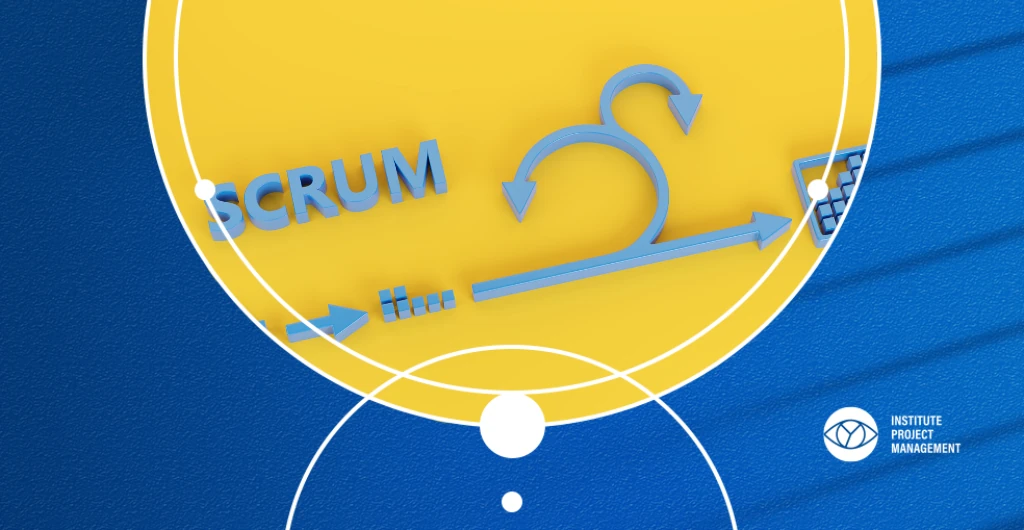
A Scrum board is tied to a sprint, which is a fixed time period, typically one to four weeks, during which a defined set of work items must be completed. At the start of each sprint, the team selects a batch of items from the product backlog and commits to delivering them by the sprint’s end. The Scrum board reflects only the work selected for that sprint. A Kanban board, by contrast, has no fixed time boundaries. Work flows continuously, with new items entering the system as capacity allows. There is no sprint cadence, no sprint planning ceremony, and no commitment to a fixed scope within a defined period. This makes Kanban particularly well-suited to operational work, support functions, or any environment where incoming requests are unpredictable and ongoing rather than batched.
Scrum is a prescriptive framework with defined roles including the Scrum Master, Product Owner, and Development Team, along with a specific set of ceremonies and artefacts. Kanban is a method rather than a framework, meaning it provides principles and practices without mandating a particular team structure or set of meetings. A team can adopt Kanban on top of an existing process with relatively little disruption, which is one reason it is so widely used as an entry point into Agile ways of working. For project managers operating in organisations not yet fully committed to Agile transformation, Kanban often offers a more pragmatic and politically feasible starting point than the full Scrum framework.
A distinction that separates IPM’s perspective from most general introductions to Kanban is the recognition that Kanban boards do not exist in isolation. They are components within broader project management methodology ecosystems, and understanding where they sit within those ecosystems is essential for any practitioner wishing to use them with professional rigour. Those interested in developing formal Agile competency should explore IPM’s Certified Agile Project Management course, which addresses exactly this integration.
The Project Management Institute’s Agile Practice Guide, co-developed with the Agile Alliance, explicitly acknowledges Kanban as a recognised Agile approach, placing it alongside Scrum, Extreme Programming, and other frameworks within the broader Agile family. IPMA’s Individual Competence Baseline likewise addresses Agile and iterative approaches as core competencies for modern project managers. Within hybrid project environments, where a project may combine traditional waterfall planning for higher-level governance with Agile execution at the team level, Kanban boards are frequently used as the execution-layer tool. The project manager maintains a traditional schedule and milestone framework at the strategic level while the delivery team manages day-to-day work through a Kanban board. This combination is increasingly common across industries including financial services, construction management, healthcare administration, and product development.
Kanban also connects directly to Lean project management, a methodology that focuses on maximising value while eliminating waste. IPM provides a thorough grounding in these connections in its resource on Lean Kanban. For project managers, understanding the Lean lineage of Kanban is not merely academic. It explains why WIP limits exist, why flow is prioritised over resource utilisation, and why Kanban boards are designed to surface problems rather than hide them. A project manager who understands these principles is equipped to defend and explain Kanban methodology decisions to stakeholders, sponsors, and senior leadership in language that is grounded in established management theory.
The practical benefits of a well-implemented Kanban board are consistently reported by project teams across sectors and scales. These benefits are not incidental features of the tool; they are direct consequences of its underlying principles applied correctly within a professional project management context.
Visibility is the most immediate benefit. When all work is represented on a shared board, the opacity that typically surrounds team workload is eliminated. Project managers spend less time chasing status updates and more time on genuine problem-solving and stakeholder management. Team members spend less time in reporting activities and more time on actual delivery. This efficiency gain is well-documented in Agile practitioner literature and consistent with the experience of IPM’s course participants worldwide.
Bottleneck identification is equally significant. Because cards accumulate visibly when a column reaches its WIP limit, blockages in a process become apparent within hours rather than days or weeks. A project manager using a traditional Gantt chart approach might not discover that a particular approval step is causing delays until those delays have already impacted the project schedule. A Kanban board surfaces the same problem the moment it begins to develop, creating an opportunity for early intervention.
Improved team communication is a subtler but important benefit. Because the board is the primary reference point for team discussions, conversations become grounded in shared, real-time information. Disagreements about priority or capacity are resolved by looking at the board together rather than by consulting conflicting spreadsheets or competing recollections. This shared reference point also supports psychological safety within teams, as it depersonalises workload discussions and focuses attention on the system rather than on individual performance.
Finally, Kanban boards support continuous improvement. The metrics naturally generated by a Kanban system, particularly cycle time (how long a card takes to pass through the system) and throughput (how many cards are completed per unit of time), give project managers objective data for process improvement conversations. These metrics are aligned with the continuous improvement principles embedded in Lean methodology and relevant to the performance domain of the PMBOK Guide’s Seventh Edition.
Creating a Kanban board requires less technical knowledge than many practitioners assume. The process is straightforward, though doing it well requires genuine engagement with the team’s actual workflow rather than a generic template. Whether you are creating a physical board with sticky notes and a whiteboard or setting up a digital equivalent, the following steps apply.
Begin by mapping your actual workflow. Before placing a single card on a board, spend time with your team identifying every stage that work genuinely passes through, from the moment a request or task is received to the moment it is considered complete. This mapping exercise frequently reveals steps that are invisible in existing processes, such as waiting for review, pending approval, or in testing, and making these visible is itself a significant improvement. Once the workflow is agreed, these stages become your columns.
Next, populate the board with current work. Each piece of active work becomes a card placed in whichever column reflects its current state. Include enough information on each card to make it meaningful: the task description, the owner, and any dependencies or deadlines. Avoid overloading cards with excessive detail; the board is a visual signal system, not a document repository.
Set WIP limits for each column based on your team’s capacity. A practical starting point is to set the WIP limit at one and a half times the number of people who work on items in that column. These limits will need adjustment as the team gains experience with the system, and refining them is a normal part of Kanban maturity. Finally, establish a regular cadence for reviewing the board as a team. Even a brief daily review significantly increases the board’s value by ensuring that blockers are addressed promptly and that priorities remain aligned with project goals. A Kanban board that is updated infrequently quickly loses its value as a real-time management tool and reverts to being a static to-do list.
A question frequently asked by project managers and teams just beginning to explore Kanban is whether specialist software is required. The answer is unequivocally no. A Kanban board can be created effectively using a physical whiteboard and sticky notes, a shared spreadsheet, or even a simple printed template pinned to an office wall. Many experienced practitioners argue that starting with a physical board is actually preferable, as the tactile act of moving cards encourages team engagement and makes the methodology’s logic more intuitive.
For teams working in spreadsheet applications, a basic Kanban board template can be constructed by creating columns across a sheet and using coloured cells or shapes to represent cards. This approach works well for smaller teams with straightforward workflows, though it does require manual updating and lacks the automatic metrics tracking available in dedicated digital platforms. The important point for any project manager to understand is that the power of a Kanban board lies in its principles, not its medium. A beautifully designed digital board used without WIP limits or regular team reviews will deliver far less value than a handwritten whiteboard used by a team genuinely committed to the methodology. This is a point that IPM’s practitioner-led teaching returns to repeatedly: methodology understanding always precedes tool selection.
For project managers at any stage of their career, developing a genuine understanding of Kanban methodology is increasingly valuable. As organisations across every sector continue to adopt Agile and hybrid delivery approaches, the ability to select, implement, and facilitate appropriate Agile tools is now a core professional competency rather than a specialist niche skill. Kanban’s low barriers to entry make it an excellent starting point for practitioners new to Agile, while its depth of methodology, rooted in Lean philosophy and supported by a rich body of practitioner research, means it continues to reward more experienced practitioners who engage with it seriously.
Understanding Kanban in the context of recognised frameworks is particularly important for those pursuing professional certification. The PMI-ACP Agile Certified Practitioner examination includes Kanban within its domain of knowledge, and candidates benefit significantly from understanding it as a methodology with theoretical underpinnings rather than simply a visual tool. Similarly, those studying for Scrum-related credentials through IPM’s Professional Scrum Master programme will find that a strong grasp of Kanban sharpens their understanding of Scrum by contrast, clarifying why each framework makes the choices it does. The two methodologies are far more illuminating when studied together than when studied in isolation.
A Kanban board is a visual tool that shows all the work a team is doing, organised into columns that represent stages in a process. Each task is displayed as a card that moves across the board as progress is made. It allows everyone involved in a project to see at a glance what work is underway, what is waiting, and what has been completed, without the need for lengthy status meetings or reports.
The five key elements of a Kanban board are the visual board itself, which provides a shared view of all work; columns, which represent the stages of a workflow; cards, which represent individual tasks or work items; WIP limits, which cap the number of items allowed in each column at any one time; and flow, which describes how smoothly work moves through the system from start to finish. Each element supports the others, and all five are necessary for a functioning Kanban system.
A Scrum board is tied to fixed time periods called sprints and is used within the Scrum framework, which prescribes specific roles, ceremonies, and artefacts. A Kanban board operates continuously without time boundaries, using a pull-based system where work enters as capacity allows. Scrum suits teams working in batches with predictable scope, while Kanban suits teams managing continuous or unpredictable workflows. Both are Agile tools, but they serve different delivery contexts.
Yes, a Kanban board can be created in a spreadsheet application by setting up columns to represent workflow stages and using rows or shapes to represent cards. While this approach requires manual updating and lacks automatic metrics, it is a perfectly legitimate starting point for teams new to the methodology. The principles of Kanban, including WIP limits and regular board reviews, can be applied regardless of the medium used to display the board.
A Kanban board is far more than a visual to-do list. Rooted in decades of Lean and Agile theory and endorsed within the world’s leading project management frameworks, it is a genuine methodology tool that gives project managers real-time visibility, early warning of problems, and a foundation for continuous improvement. Understanding it thoroughly, from its Toyota origins to its application in hybrid PM environments, is an investment that pays dividends throughout a project management career. Explore IPM’s full range of Agile project management courses to take the next step.
| Key Aspect | What to Know | Why It Matters |
|---|---|---|
| Core purpose | Visualise workflow and track task progress across process stages | Eliminates status meeting overload and provides real-time project visibility |
| WIP limits | Maximum number of cards permitted in each column simultaneously | Reduces context-switching, surfaces bottlenecks early, and improves output quality |
| Flow metrics | Cycle time and throughput measured through card movement data | Provides objective evidence for process improvement conversations with stakeholders |
| Framework alignment | Recognised within PMI Agile Practice Guide and IPMA competence frameworks | Supports professional certification and career development in Agile PM |
| Implementation medium | Physical whiteboard, spreadsheet template, or digital platform | Accessible to any team regardless of budget or technical infrastructure |
| Kanban vs Scrum | Kanban is continuous and pull-based; Scrum uses fixed sprint cycles | Allows project managers to select the right Agile approach for their delivery context |