All Courses
 Upcoming Course Dates
 Professional Courses
 Academy & Short Courses
 IPM Courses
 PMI Courses
 IPMA Courses
 PRINCE2 Courses
 Corporate Training
 Corporate Partnership
 University Partnership
 Strategic Partnership
 IPM Competency Pathway
 Growth Partner
 View More Academy Course
 IPMA Certification
 PMI Certification
 IPM CPM Level 1
 IPM CPM Level 2
 IPM CPM Level 3
 IPM-AI
 IPM-Sustainable
 IPM-SCRUM
 IPM-PMO
 IPM-AGILE
 IPM-ASSOCIATE
 About IPM Hub
 IPM Membership
 EMEA Monthly Events
 Mentorship
 All Resources
 Expert Insights
 Ebooks & Toolkits
 Publish Your Writing
 IPM Jobs Portal
 The Institute
 Our Team & Faculty
 Global Advisory Board
 Apply to Lecture or Volunteer
 Apply to Intern or Campus Ambassador
 Speak to an Advisor


hamburger__close
Project management is the structured discipline of planning, organising, and controlling the work required to achieve a specific goal within defined constraints of time, cost, and quality. It involves applying knowledge, skills, tools, and processes to guide a temporary endeavour from initial idea through to successful delivery, enabling individuals, teams, and organisations to produce defined outputs and realise meaningful outcomes.

At its simplest, project management is the practice of applying a structured approach to turning an idea, problem, or organisational need into a tangible result. Every project has a beginning and an end, a set of deliverables to produce, and a team of people working together to produce them. Project management provides the framework that keeps all of those moving parts aligned and purposeful.
Earn your Project Management Diploma & IPMA® Certification with expert-led training at IPM to confidently manage any project.

The discipline draws on a body of knowledge that has been codified, refined, and internationally standardised over decades. ISO 21502:2020, the global standard for project management guidance, defines a project as a unique, temporary endeavour undertaken to achieve intended objectives. Project management, in that context, is the application of methods, processes, knowledge, skills, and experience to achieve the project objectives. What makes this definition powerful is not its technical precision, but the clarity it brings to how organisations can approach complex change in a repeatable, measurable, and accountable way.
For someone new to the field, the most important thing to understand is that project management is not about paperwork or bureaucracy. It is about giving focused work a clear structure so that teams can collaborate effectively, problems can be identified early, and success can be recognised and repeated. Whether you are coordinating a small internal initiative or overseeing a multi-million euro infrastructure programme, the underlying principles remain consistent: define what needs to be done, plan how to do it, execute with discipline, monitor progress, and close with intention. Those looking to build these skills from the ground up will find that IPM’s project management resources offer a strong starting point for developing both awareness and applied knowledge.
Before exploring how projects are managed, it helps to be clear about what a project actually is. Not all work is a project. In every organisation, a great deal of activity is operational: the day-to-day processes that keep the business running, such as processing invoices, delivering customer service, or maintaining systems. These activities are ongoing, repetitive, and designed to be stable over time.
A project, by contrast, is temporary and unique. It has a defined start point, a defined end point, and a specific set of outputs it exists to produce. Once those outputs are delivered and the objectives are met, the project closes. A construction firm building a new office block, a hospital implementing a new patient records system, a charity running a fundraising campaign: each of these is a project. They share three defining characteristics.
The first is a finite time span. Projects have deadlines and milestones, not indefinite horizons. The second is defined outputs and outcomes. A project must produce something specific, whether that is a product, a service, a facility, or a change in organisational capability. The third is a degree of uniqueness. Even familiar types of projects will differ from previous ones in their context, stakeholders, constraints, or risk profile. This combination of temporality, specificity, and uniqueness is precisely why a dedicated management discipline is needed: ongoing management approaches designed for stability are not well suited to the focused, bounded, change-oriented nature of project work.
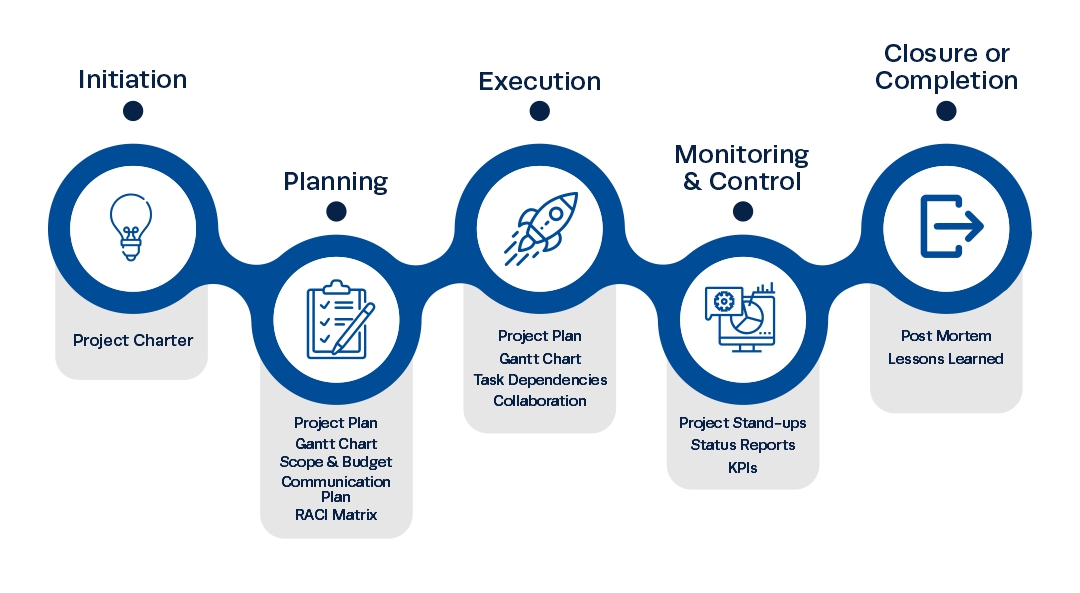
The project management lifecycle provides a logical structure for the full journey of a project from first conception through to completion. Most internationally recognised frameworks, including those aligned to IPMA and ISO 21502, describe five phases, and understanding these phases answers one of the most common questions asked by those new to the field: what are the 5 stages of project management?
The first phase is initiation. This is where the project is defined at a high level. A business case is developed, key stakeholders are identified, and a decision is made about whether the project is viable and worth pursuing. The output is typically a project charter or initiation document that formally authorises the project to proceed. The second phase is planning. This is often the most intellectually demanding stage, as it is where the project manager and the team work out in detail how the project will be delivered. The scope is defined, a schedule is built, resources are identified, risks are assessed, and a baseline plan is agreed upon. Planning is not a one-time event; it is revisited and refined throughout the project as new information emerges.
The third phase is execution, where the actual work of the project takes place. Teams are mobilised, tasks are carried out, and deliverables begin to take shape. Effective execution depends on clear communication, strong leadership, and the ability to make decisions quickly when circumstances change. The fourth phase, monitoring and control, runs in parallel with execution. It involves tracking progress against the baseline plan, measuring performance, identifying variances, and taking corrective action when needed. This phase is what gives project management its rigour: without it, problems go undetected until they become crises.
The fifth and final phase is closure. This is where the project is formally brought to an end. Deliverables are handed over, stakeholder sign-off is obtained, contracts are closed, and the team is released. Critically, closure also involves capturing lessons learned, documenting what worked and what did not, and ensuring that the knowledge gained is available to inform future projects. Together, these five phases represent the complete arc of a project and provide the backbone for nearly every project management methodology in use today.
If you are ready to take your understanding of project management from theory into practice, the next step is to find a programme that matches your experience level and career ambitions. IPM offers a range of structured, practitioner-led programmes for every stage of the project management journey. Explore IPM’s project management courses and find the pathway that is right for you.
Within the project lifecycle, project management is built on a set of core components that must be actively managed for a project to succeed. These are sometimes called the project management knowledge areas or management domains, and they collectively answer the question: What are the 5 basics of project management?
Scope management is the discipline of defining and controlling what the project will and will not deliver. Scope creep, the gradual expansion of project requirements without corresponding adjustments to time or cost, is one of the most common causes of project failure, making this a foundational discipline. Time management involves developing and maintaining the project schedule: identifying activities, sequencing them logically, estimating durations, and tracking progress against milestones. Cost management covers the estimation, budgeting, and control of expenditures throughout the project lifecycle, ensuring the project delivers value within its financial boundaries.
Risk management is the proactive identification, analysis, and response to events that could affect the project’s objectives. Projects are inherently uncertain, and the ability to anticipate and prepare for risks is what separates reactive teams from high-performing ones. Quality management ensures that the outputs of the project meet defined standards and are fit for purpose. Beyond these five core areas, effective project management also encompasses stakeholder engagement, communications management, resource management, and procurement management, each of which demands skill, judgement, and structured attention throughout the project lifecycle.
Certify your skills with IPM’s Risk Management Course, earning PMI-RMP® certification in identifying, analyzing, and addressing risks.

A methodology is the overarching framework a project team uses to organise its work. Different methodologies suit different types of projects, different organisational cultures, and different levels of certainty about what the final output will look like. Understanding the main approaches is an important part of developing project management skills, and most professional project managers become competent in more than one.
Waterfall, sometimes called the traditional or predictive approach, organises project work into sequential phases. Each phase must be completed before the next begins, and the full scope of the project is defined upfront. This approach works well when requirements are clear, stable, and well understood from the outset, as is often the case in construction, engineering, and manufacturing projects. PRINCE2 (Projects in Controlled Environments) is a structured methodology widely used in the United Kingdom, Europe, and internationally. It provides a detailed process framework with defined roles, stages, and management products, and is particularly valued in public sector and enterprise environments for the governance and accountability it provides.
Agile project management emerged from the software development world but has since been adopted across many sectors. Rather than defining the full scope upfront, Agile approaches work in short iterative cycles called sprints or iterations, delivering working increments of the product at regular intervals. This allows teams to respond to changing requirements and incorporate stakeholder feedback continuously. Scrum and Kanban are the most widely used Agile frameworks, though many organisations adapt Agile principles to their specific context rather than adopting any single framework wholesale.
Hybrid approaches combine elements of both predictive and Agile methods, recognising that most real-world projects are neither fully stable nor fully uncertain. A construction project might use a Waterfall approach for its structural engineering work while applying Agile techniques to the fit-out and interior design phases. The ability to select and adapt a methodology to the context of the project is one of the marks of an experienced and competent project manager, and it is a skill that international competence frameworks such as the IPMA Individual Competence Baseline actively assess and develop.
The project manager is the individual accountable for the overall success of the project. This does not mean doing all the work; it means ensuring that the right work gets done by the right people, in the right sequence, and to the right standard. Understanding the role of a project manager is essential for anyone considering a career in the field or looking to appoint one within their organisation.
In practice, the project manager’s responsibilities span the full lifecycle. During initiation and planning, they develop the business case, define the scope, build the schedule, identify risks, and engage stakeholders. During execution, they lead the team, manage communications, make decisions, resolve issues, and keep the project on track. During monitoring and control, they track performance, analyse variances, and take corrective action. During closure, they ensure that deliverables are accepted, lessons are captured, and the project is formally concluded. This breadth of responsibility is what makes project management such a demanding and rewarding profession.
The question of what the main 5 roles of project management are is best answered not by listing job titles but by describing the capability dimensions a project manager must demonstrate: leader, planner, communicator, risk thinker, and decision-maker. These roles are rarely separate; they overlap and interplay constantly throughout a project.
Technical project management skills include scheduling, budgeting, risk assessment, and the use of planning tools. But the research and the experience of practitioners consistently show that it is the behavioural and contextual competences that most often determine whether a project succeeds or fails. The ability to build trust, manage conflict, communicate clearly under pressure, influence without authority, and maintain focus when priorities shift: these are the skills that distinguish exceptional project managers from competent ones. The IPMA Individual Competence Baseline organises these competences into three domains: technical, leadership, and strategic context, providing a comprehensive and internationally recognised model for professional development in project management.
Organisations invest in project management because it delivers measurable value. The evidence is consistent and compelling: projects that are managed with discipline and structure are significantly more likely to be delivered on time, within budget, and to the satisfaction of stakeholders than those that are not. The Project Management Institute’s Pulse of the Profession research has repeatedly shown that organisations with mature project management practices waste considerably less money through failed or challenged projects than those without.
Beyond individual project outcomes, the strategic value of strong project management capability is substantial. Organisations that manage projects well are better able to implement their strategic priorities, respond to change, and build the internal competence needed to sustain competitive advantage. Project management provides a common language for discussing change, a shared framework for prioritising investment, and a culture of accountability that benefits the whole organisation.
For individuals, project management is one of the most transferable and globally portable professional skills available. A qualified and experienced project manager can work across sectors, countries, and organisational types, because the discipline is grounded in universally applicable principles rather than industry-specific knowledge. This is one of the reasons why demand for skilled project managers continues to grow globally, and why project management salary data consistently places it among the higher-earning professional disciplines, with senior project managers and programme managers in Europe typically earning between €60,000 and €120,000 or more, depending on sector, seniority, and geography.
Project management is not simply a collection of useful techniques. It is a recognised global profession, supported by internationally accepted standards, competence frameworks, and certification pathways. Understanding this standards landscape is important for anyone thinking about project management as a career, and for organisations evaluating how to develop their project delivery capability.
ISO 21502:2020 provides internationally agreed guidance on project management, establishing common terminology and principles that transcend individual methodologies or national contexts. It is designed to complement, rather than replace, other frameworks, and is increasingly used by organisations and governments as a reference standard for procurement and governance. The IPMA (International Project Management Association) framework takes a competence-based approach, defining what project managers need to know, what they need to be able to do, and how they need to behave in order to manage projects effectively. The IPMA Individual Competence Baseline, currently in its fourth edition, is used in over 70 countries and provides the foundation for a four-level certification pathway that recognises everything from project management fundamentals through to strategic programme and portfolio management.
For individuals entering the profession, certification provides a structured and credible path from awareness to competence. IPMA certification pathways, accessible through bodies such as IPM, are designed to meet practitioners at their level, whether they are just starting out or looking to demonstrate senior-level competence to employers and clients. You can explore IPMA certification pathways to understand which level is most appropriate for your current experience and career goals.
Unlike vendor certifications tied to specific tools or software platforms, IPMA certification is grounded in internationally recognised competence standards and is assessed through a combination of written examination and practical portfolio evidence. This makes it one of the most rigorous and respected credentials available to project managers globally. For organisations, supporting staff to achieve recognised certification is not simply a training investment: it is a direct contribution to project delivery performance, organisational reputation, and the ability to attract and retain skilled professionals in an increasingly competitive talent market.
One of the best ways to understand what project management looks like in practice is to consider concrete examples across different sectors, because the discipline is genuinely universal in its application.
In the construction sector, a project manager overseeing the development of a new hospital will be responsible for coordinating dozens of contractors and suppliers, managing a schedule spanning several years, controlling a budget of tens or hundreds of millions of euros, and ensuring that the finished facility meets stringent regulatory, safety, and clinical standards. Every delay, every budget variance, and every design change will need to be formally assessed, communicated to stakeholders, and responded to through the project management framework.
In the technology sector, a project manager leading the implementation of a new enterprise resource planning system will face a different but equally complex set of challenges: managing organisational change, aligning technical requirements with business needs, coordinating internal teams with external vendors, and delivering a system that genuinely improves the way the organisation operates. In the not-for-profit sector, a project manager running a community infrastructure programme will need to balance multiple funder requirements, demonstrate social impact, and maintain transparency with a broad range of stakeholders, all while managing limited resources with precision. What these examples share is not the technology or the industry: it is the structured, disciplined, human-centred approach that project management brings to complex, temporary, goal-oriented work.
For those asking what a project management course involves, or how to begin building a career in the field, the good news is that the profession has a well-defined and accessible entry point. Project management education does not require a specific undergraduate background. People enter the profession from engineering, finance, healthcare, education, the arts, and virtually every other field because the core competencies are learnable and the demand for them is sector-agnostic.
A structured project management course will typically cover the fundamentals of the project lifecycle, the key knowledge areas and management domains, the major methodologies and when to apply them, and the behavioural and leadership skills that distinguish effective project managers from purely technically proficient ones. The best courses, particularly those aligned to internationally recognised frameworks such as IPMA, go further: they connect theory to practice, use real-world case studies, and prepare participants for formal assessment and certification. The Certified Project Management Diploma is one such programme, designed to equip practitioners with both the technical foundation and the applied confidence needed to lead projects in any sector.
Earn your Project Management Diploma & IPMA® Certification with expert-led training at IPM to confidently manage any project.
IPM has been designing and delivering practitioner-led project management education since 1989, and our programmes are built on the same principles that inform the IPMA competence framework: that project management is a holistic discipline requiring technical knowledge, interpersonal skills, and strategic awareness in equal measure. Whether you are a complete beginner looking to understand the fundamentals, a practising project manager seeking formal recognition of your experience, or an organisation looking to build project management capability across a team, there is a structured, credible, and internationally recognised pathway available to you.
Project management is the structured practice of planning, organising, and controlling work to achieve a specific goal within defined boundaries of time, cost, and quality. It applies a consistent set of processes and skills to guide a temporary endeavour from initial idea through to successful delivery, ensuring that the right outcomes are achieved for the people and organisations involved.
The five core components of project management are scope management, time management, cost management, risk management, and quality management. Together, these areas define what the project will deliver, how long it will take, what it will cost, what could go wrong and how to prepare, and whether the final output meets the required standard. All five must be actively managed throughout the project lifecycle.
The five stages of the project management lifecycle are initiation, planning, execution, monitoring and control, and closure. Initiation defines the project at a high level and authorises it to proceed. Planning works out in detail how the project will be delivered. Execution is where the work takes place. Monitoring and control tracks progress and addresses problems. Closure formally ends the project and captures lessons learned.
Rather than five separate job titles, the five role dimensions every project manager must fulfil are: leader, responsible for guiding the team; planner, responsible for structuring the work; communicator, responsible for keeping stakeholders informed; risk thinker, responsible for anticipating and responding to uncertainty; and decision-maker, responsible for resolving issues and keeping the project on track. These dimensions are all reflected in internationally recognised competence frameworks such as IPMA.
A project is temporary and unique: it has a defined start, a defined end, and a specific set of outputs to deliver. Ongoing operations, by contrast, are the repetitive, continuous activities that keep an organisation functioning day to day. Project management is specifically designed for the temporary, change-oriented nature of project work, which requires a different approach to planning, resourcing, and governance than operational management.
There is no single mandatory qualification for working in project management, but internationally recognised certifications significantly strengthen both competence and career prospects. IPMA certification, available through bodies such as IPM, provides a four-level pathway from foundational knowledge through to senior programme and portfolio management. Certification is assessed against globally accepted competence standards and is valued by employers across sectors and countries.
| Key Aspect | What to Know | Why It Matters |
|---|---|---|
| Definition | The structured discipline of planning, executing, and controlling temporary work to achieve defined objectives within agreed constraints | Provides a common framework for delivering change reliably and accountably |
| Project Lifecycle | Five phases: Initiation, Planning, Execution, Monitoring and Control, Closure | Gives every project a clear structure from first idea to final delivery |
| Core Components | Scope, time, cost, risk, and quality management | Ensures all critical dimensions of a project are actively managed and balanced |
| Key Methodologies | Waterfall, PRINCE2, Agile, and Hybrid approaches | Allows practitioners to select the right approach for the context and complexity of each project |
| The Project Manager | Accountable for leading the team and delivering the project to agreed scope, time, cost, and quality | Creates a single point of ownership and accountability for project outcomes |
| Global Standards | ISO 21502:2020 and the IPMA Individual Competence Baseline provide internationally recognised frameworks | Enables organisations and individuals to benchmark and develop capability against globally accepted standards |
| Professional Certification | IPMA offers a four-level certification pathway from foundation to senior strategic level | Provides credible, portable, and employer-recognised evidence of project management competence |
| Organisational Value | Mature project management practice reduces waste, improves delivery performance, and supports strategic execution | Delivers measurable return on investment through better-managed projects and stronger organisational capability |
Project management is one of the most practically valuable and globally transferable professional disciplines available. It gives organisations the structure they need to deliver strategic change reliably, and it gives individuals a rewarding, well-compensated, and internationally recognised career path. Whether you are approaching this field out of curiosity or with a clear professional goal in mind, the foundation you build now will serve you across every sector and every stage of your career. Explore IPM’s project management courses to take the next step with confidence.