IPM CPM Level 1


hamburger__close
RAG status is a project reporting method that uses three colours, Red, Amber and Green, to communicate the current health of a project quickly and clearly to stakeholders, senior leaders and governance boards. Each colour signals a different level of concern and triggers a different management response. For project managers new to structured reporting, understanding RAG status is one of the most practical and immediately applicable skills you can develop. It sits at the heart of how projects are monitored, escalated and controlled across virtually every sector and organisation size worldwide. If you are looking to build a strong foundation in reporting and project governance, the IPM CPM Level 1 certification develops exactly these competencies through real project work and structured assignments.
Earn your Project Management Diploma & IPMA® Certification with expert-led training at IPM to confidently manage any project.

RAG status is a colour-coded indicator used in project management to summarise the overall health or progress of a project at a given point in time. The acronym stands for Red, Amber and Green. Each colour communicates a distinct condition: Green means the project is on track, Amber signals a concern that requires attention but has not yet become critical, and Red indicates a serious issue that demands immediate intervention from senior stakeholders or sponsors.
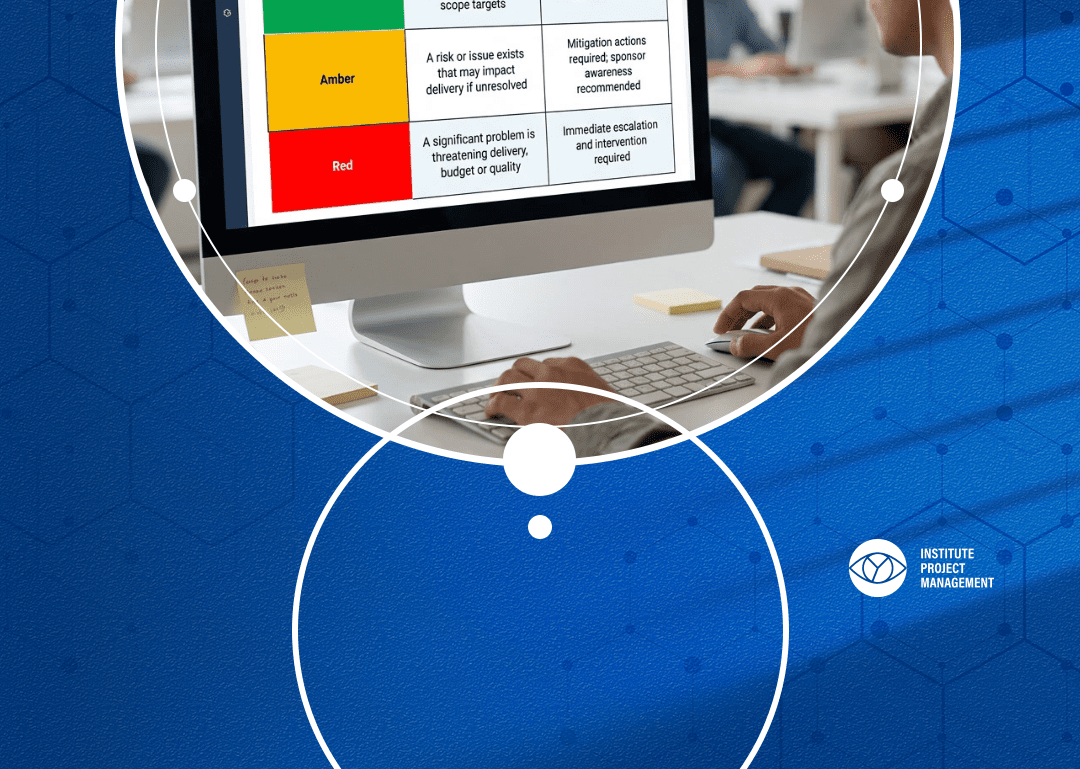
| Status | Meaning | Required Action |
|---|---|---|
| Green | Project is on track against time, cost and scope targets | Continue monitoring; no escalation required |
| Amber | A risk or issue exists that may impact delivery if unresolved | Mitigation actions required; sponsor awareness recommended |
| Red | A significant problem is threatening delivery, budget or quality | Immediate escalation and intervention required |
The simplicity of RAG reporting is precisely what makes it so effective. Executives and board members can absorb the status of dozens of projects in seconds, allowing attention and resources to flow where they are most needed. However, as we will explore throughout this article, the apparent simplicity of three colours masks a discipline that requires genuine professional judgement, clearly defined thresholds and, above all, a commitment to honesty.
Understanding what each colour means in theory is straightforward. Understanding what it means in the context of your specific project, your organisation and your stakeholder expectations is where professional competence comes in.
RAG status is not a standalone tool. It is one component within a broader project governance and assurance framework, and understanding where it sits within that structure transforms it from a simple colour label into a meaningful governance instrument.
In most mature project environments, RAG status is reported across multiple dimensions simultaneously. A project might carry a Green status for budget, an Amber for schedule and a Red for a specific risk. These dimension-level ratings are then consolidated into an overall project RAG status, a process that itself requires professional judgement about relative priority and materiality. This consolidated view is what appears on programme dashboards, portfolio reports and executive briefings. For a practical overview of how these dashboards are structured, IPM’s KPI dashboard template offers a useful reference point.
Within a portfolio management context, RAG status enables senior leaders and PMO functions to make resource allocation decisions across multiple projects simultaneously. If three projects in a portfolio are simultaneously Red, the organisation faces a capacity and priority question that goes beyond any individual project manager’s remit. This is the domain of programme and portfolio management, a level of practice validated through the IPM CPM Level 2 certification, which equips practitioners to manage interdependencies, escalation flows and governance structures across complex portfolios.
Attend IPM’s Strategic Project Programme Management Diploma to gain expertise in executing programmes with strategic leadership excellence.
Project assurance functions, whether internal audit teams, PMO reviewers or external sponsors, use RAG status as a first filter. A consistently Green project that subsequently fails is a significant governance failure. An honest pattern of Amber, followed by timely intervention and a return to Green, is a sign of a well-governed project. RAG status, reported faithfully over time, creates an audit trail of project health that serves accountability, learning and organisational improvement.
If you are building your project reporting skills from the ground up, understanding how RAG status connects to broader project monitoring and control is an essential step. IPM’s Risk Management Course covers the risk and issue management disciplines that give your RAG reporting its evidential foundation, ensuring your status assessments are grounded in structured analysis rather than intuition.
One of the most common weaknesses in RAG reporting is subjectivity. Without pre-agreed thresholds, two project managers facing identical situations may report different statuses, and neither can be told they are wrong. This inconsistency undermines the value of RAG reporting at the portfolio level and erodes stakeholder trust over time.

The solution is to define RAG criteria at the outset of a project, during the planning phase, and to document them within the project management plan or governance framework. These criteria should be specific, measurable and agreed upon by the project sponsor and key stakeholders before reporting begins. A typical set of schedule thresholds might look like this: Green if the project is within five per cent of the planned schedule, Amber if between five and fifteen per cent behind, and Red if more than fifteen per cent behind with no approved recovery plan. The same logic applies to budget variance, scope change requests, risk exposure scores and quality indicators.
Setting these thresholds is not a purely technical exercise. It requires a conversation about risk appetite, which differs between organisations, sectors and project types. A five per cent schedule variance in a regulatory compliance project with a statutory deadline carries very different implications from the same variance in an internal process improvement project. Context shapes what each colour should mean, and that contextual judgement is precisely what distinguishes a credentialled project manager from someone simply filling in a status report.
Once thresholds are agreed, they should remain stable throughout the project unless a formal change control process approves a revision. Changing thresholds mid-project to avoid an uncomfortable Red status is a governance failure, and one that experienced project assurance professionals will recognise immediately.
A common question among practitioners moving between traditional and agile delivery environments is whether RAG status has a place in agile projects. The short answer is yes, though its application requires some adaptation.
In agile environments, project health is primarily communicated through sprint reviews, velocity charts, burndown charts and impediment logs. These mechanisms offer a granular, real-time picture of progress that complements or sometimes replaces traditional status reporting. However, at the programme level, at the portfolio level and in any stakeholder reporting that extends beyond the delivery team itself, RAG status remains a highly practical communication tool. Executives and steering committees do not typically read burndown charts. They read status reports, and those reports benefit from the immediate clarity that RAG indicators provide.
In a scaled agile context, such as environments using SAFe or other large-scale frameworks, RAG status often appears at the programme increment level, summarising the health of epic delivery, dependency resolution and risk management across multiple teams. The underlying data feeding that status comes from agile ceremonies and artefacts, but the reporting output uses the same Red, Amber, Green logic that any senior stakeholder can interpret. Practitioners building expertise in agile delivery alongside structured reporting disciplines may find the IPM Agile Project Professional certification a valuable complement to their foundational project management knowledge, and the IPM Scrum Project Professional certification provides deeper grounding in team-level delivery practices that feed into programme-level RAG reporting.
This is the dimension of RAG reporting that most articles ignore, and it is arguably the most important one. RAG status is not a neutral data output. It is a professional judgement, communicated by an individual who has a responsibility to their organisation, their stakeholders and, in regulated sectors, potentially to the public. That responsibility brings with it an ethical dimension that every credentialled project manager must take seriously.
The pressure to maintain Green status is real in most organisations. Project managers who report Amber or Red can find themselves subject to uncomfortable scrutiny, questioned about their competence or blamed for problems that may have systemic or organisational roots. In response, some practitioners default to what is sometimes called watermelon reporting. It is green on the outside, Red on the inside. The report looks healthy, but the reality beneath the surface is not. Watermelon projects tend to fail without warning because the governance mechanisms that exist to identify and address problems have been bypassed by dishonest reporting.
The antidote to watermelon reporting is twofold. First, it requires individual practitioners who understand that their professional reputation is built on the quality and honesty of their judgements, not on the number of Green statuses they deliver. Second, and more fundamentally, it requires organisational leadership that creates a psychologically safe environment for honest reporting. If an organisation consistently punishes bearers of bad news, it will get less bad news and more bad surprises. Senior leaders and sponsors have a direct responsibility to respond to Amber and Red status reports with support, curiosity and problem-solving rather than blame.
IPM’s approach to practitioner development, grounded in over 35 years of experience and aligned with IPMA’s international competence standards, treats this ethical and behavioural dimension of project management as a core professional competency, not an optional add-on. A project manager who can read a risk register but cannot have an honest conversation with a sponsor about project health is not yet a complete practitioner. Reporting with integrity, in structured assignments and real project work, is precisely what the IPM CPM Level 1 certification develops in its candidates.
Earn your Project Management Diploma & IPMA® Certification with expert-led training at IPM to confidently manage any project.
Experience across thousands of project environments reveals a consistent set of reporting errors. Recognising them is the first step to avoiding them.
The most common mistake is applying RAG status without pre-defined thresholds, as discussed earlier. Without agreed criteria, status becomes a subjective feeling rather than an evidence-based assessment. The fix is straightforward: define your thresholds during planning, document them and get stakeholder sign-off before reporting begins.
The second mistake is reporting an overall project RAG without breaking it down by dimension. A single colour applied to an entire project hides more than it reveals. A project can be perfectly on budget while seriously behind schedule. Reporting dimension-level RAG, covering at a minimum time, cost, scope and risk, gives decision-makers the information they actually need. For guidance on structuring this kind of report effectively, IPM’s progress report template provides a practical framework.
The third mistake is treating RAG as a point-in-time snapshot without trend context. A project that has moved from Red to Amber to Green over three consecutive reporting periods tells a very different story from one that has been Amber for six consecutive periods with no apparent movement. Trend reporting alongside current status dramatically increases the governance value of RAG data.
The fourth mistake is conflating confidence with status. A project manager may be highly confident that a risk will not materialise, but if that risk, if it did materialise, would threaten delivery, the status should reflect the exposure rather than the manager’s personal optimism. RAG reporting is about what the evidence says, not about how the project manager feels.
Finally, some practitioners make the mistake of allowing RAG status to float upward without a formal recovery plan. A project should not move from Red to Amber unless a documented recovery action has been agreed and is being executed. Similarly, moving from Amber to Green requires evidence that the underlying issue has been resolved, not merely that it has been forgotten. The IPM Risk Management Course provides structured training in the risk and issue management processes that underpin credible RAG reporting.
To make this concrete, consider a mid-sized technology implementation project in a financial services organisation. The project has a budget of €1.2 million, a twelve-month delivery timeline and a defined scope covering system migration, user training and regulatory reporting capability.
At the end of month six, the project manager compiles the status report. Budget performance is tracking at three per cent underspend against plan, comfortably within the agreed five per cent Green threshold. The budget dimension is rated Green. Schedule performance shows the project is running two weeks behind on the migration workstream due to a delayed data cleansing exercise from a third-party supplier. This puts schedule variance at eight per cent, which crosses the Amber threshold. The project manager rates the schedule as Amber and documents a recovery plan: the supplier has committed to accelerated delivery over the following fortnight, and two internal resources have been reallocated to support the workstream. Risk exposure has increased because a regulatory deadline has been confirmed two weeks earlier than previously communicated, which tightens the schedule tolerance further. Risk is rated Amber.

The overall project status, a consolidated judgement across all dimensions, is rated Amber. The report documents the specific issues, the recovery actions in place and the escalation request: the project sponsor is asked to formally confirm the reallocation of internal resources and to engage with the third-party supplier at a senior level to reinforce the accelerated delivery commitment.
This is RAG reporting working as it should. The status is honest, evidence-based, and accompanied by context and a clear call to action. The sponsor receives exactly the information they need to make a useful decision. No surprises, no blame, no watermelons. This level of reporting discipline, applied consistently across a project lifecycle, is what separates governance-aware practitioners from those merely tracking tasks.

| Key Aspect | What to Know | Why It Matters |
|---|---|---|
| Green Status | Project performing within all agreed tolerances | Confirms governance health; no escalation required |
| Amber Status | Issue or risk identified that requires attention and mitigation | Enables early intervention before problems become critical |
| Red Status | Serious problem threatening delivery, budget or quality | Triggers formal escalation and sponsor decision-making |
| Defined Thresholds | Pre-agreed criteria set during the planning phase | Removes subjectivity and builds stakeholder trust in reporting |
| Honest Reporting | Status reflects evidence, not optimism or political pressure | Prevents watermelon projects and governance failure |
| Trend Context | Direction of travel reported alongside current status | Gives decision-makers a more complete picture of the project trajectory |
RAG status is one of the most widely used tools in project management precisely because it translates complex project realities into clear, actionable information for the people who need to make decisions. But its power depends entirely on the integrity with which it is applied. Defined thresholds, honest assessment, and a governance culture that welcomes early warning signals are what transform RAG from a colour-coding exercise into a genuine professional discipline. If you are ready to develop these skills in a structured, credentialled way, IPM’s certification programmes offer the practical foundation you need.
RAG status is a colour-coded reporting method used in project management. Red indicates a serious problem requiring immediate escalation. Amber signals a concern that needs attention before it becomes critical. Green means the project is performing within agreed tolerances. Together, the three colours allow stakeholders and senior leaders to assess project health at a glance and direct attention and resources where they are most needed.
RAG is an acronym standing for Red, Amber and Green. In a project management context, these three colours represent the current health status of a project or a specific dimension of it, such as schedule, budget or risk. The RAG framework is used across sectors, including construction, technology, healthcare, finance and government, to provide clear, consistent and accessible project reporting.
In agile environments, RAG status is most commonly used at the programme or portfolio level rather than within individual delivery teams. Agile teams typically use velocity charts, burndown charts and sprint reviews to communicate progress internally. However, for executive and stakeholder reporting, RAG indicators provide a clear summary of programme health that complements agile delivery artefacts and ensures decision-makers have the information they need.
The standard RAG framework uses three colours, not four. However, some organisations extend it to a four-status model by adding Blue, which typically indicates a completed or closed item, or by splitting Amber into two bands to differentiate between early-stage concerns and more serious ones approaching Red. The extended model is sometimes called BRAG (Blue, Red, Amber, Green) and is used in portfolio reporting environments where additional granularity is needed.
The project manager is typically responsible for assigning RAG status and ensuring it reflects an honest, evidence-based assessment of project health. In larger programmes, a programme manager or PMO may consolidate individual project statuses into a portfolio-level view. Regardless of who compiles the report, RAG status should be based on pre-agreed thresholds documented in the project governance framework and reviewed by the project sponsor.
In practice, a project should move from Red to Amber once a credible recovery plan is in place and initial actions are showing results, and then from Amber to Green once the underlying issue is resolved. Moving directly from Red to Green in a single reporting period is possible, but should be accompanied by clear evidence of recovery. Skipping the intermediate Amber stage without documented justification can undermine the credibility of the reporting process.
For practitioners who want to develop these governance and reporting skills in a structured, professionally recognised way, the IPM CPM Level 1 certification builds competence in project monitoring, control and stakeholder communication through real project assignments, not exam memorisation alone. For those working at programme or portfolio level, where RAG reporting feeds executive decision-making across multiple concurrent projects, the IPM CPM Level 2 certification develops the strategic governance capabilities that this level of responsibility demands.
Attend IPM’s Strategic Project Programme Management Diploma to gain expertise in executing programmes with strategic leadership excellence.