IPM CPM Level 1


hamburger__close
When the word “manager” is used, the majority of people often think of a leader. Being in charge, making decisions, and carrying the responsibilities to make the project successful are just some of the examples of what managers and leaders do. However, there are some differences between manager and leader that are not just in the title. Their roles are more different than you may think. If you are looking to build your expertise in this area, exploring project management courses is a great place to start.
Boost your skills with leadership and management courses at IPM. Earn valuable IPMA-B/A certification for career growth.

First of all, it is important to note that leadership is not just a position – it is a set of skills, behaviours, and attitudes. It is not reserved only for the person who is in a position of leading a team; it is something every team member should demonstrate. But when speaking of leadership as a title, there are several types – project leadership being just one of them.
Project leaders are the ones who engage people – they motivate them, give them clues and ideas, listen to them and pay attention to how the employees feel. Having that positive atmosphere at work increases the productivity of the workers. And that is the main reason having great leadership skills is important.
But leadership is also about guidance. Projects are made up of many different people who are contributing, and obviously, they will need someone to guide them through the process. That is the responsibility of a project leader. They have to deliver the results with the project team members they have, but seeing as projects are temporary, there can be some changes mid-way. Sometimes team members change in different phases or, for some projects, the plan itself changes halfway through, for example when the scope evolves based on stakeholder feedback. Project teams can be made up of people from different departments, divisions, locations, and even different organisations. Each team member brings a different set of skills, collaborating with the rest to create something new and unique. So, the key responsibility of a project leader is to give clear direction and guide people through their tasks in case of obstacles. Their main concern is the project’s outcome – they are aiming to make sure the project is carried out in the best way possible and that every detail is taken care of.
Project managers are in charge of taking care of the entire team – making schedules and helping out with problems other team members face. They are organised and goal-oriented. They make project goals their own and inspire the rest of the team to feel the same shared purpose towards the goal.
Project managers foster the people skills needed to develop trust and communication among all of the project’s stakeholders. They are in charge of breaking complex tasks down into subtasks that they then document, monitor and control, adjusting steps to each project. Part of a project manager’s job is also to review the project once it is complete and capture lessons learned that improve their own and their team’s skills. All of these tasks show why good management is fundamental to an organisation’s success and to winning and keeping its position in the market.

Develop leadership and negotiation skills with our leadership and management courses, essential for project managers’ success.

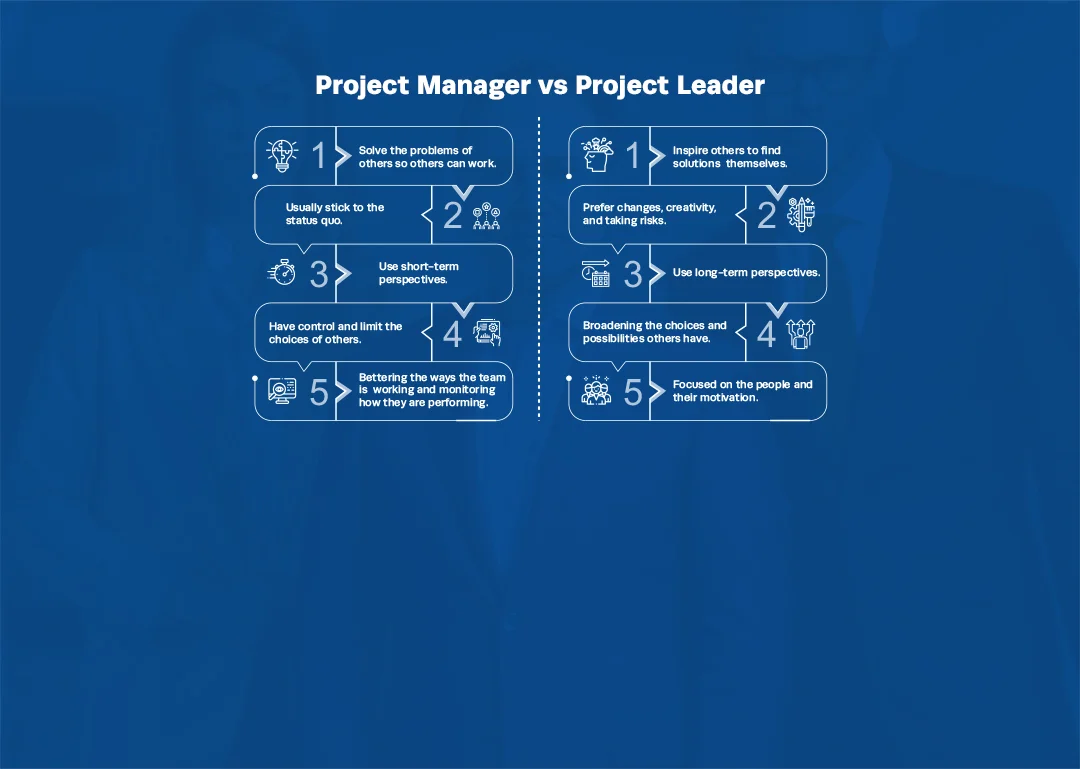
If the two roles still sound similar, here is a summary of the main differences:

But the main difference is – leaders care about doing the right thing, while managers care about doing it the right way. In other words, leaders start from a question, “What are we supposed to do?” while managers start from “How can we make what we already do better?” Leaders focus on vision, mission, and general and specific goals, while managers focus on productivity and efficiency.
Organisations need both leaders and managers, despite their differences, or better yet – because of their differences. Managers have a crucial role in overseeing daily tasks, and leaders have a key role in inspiring others and deciding on a long-term path for the company’s development.
Leadership is one of the most valued skills in today’s business world. Being a leader requires not only technical skills but also strategic ones like communicating the project vision, goals, and objectives. It also includes soft skills like emotional intelligence, motivation and team development. For those looking to develop these competencies in a structured way, the Project Leadership and Management Diploma covers all of these areas in depth.
One of the most important factors that separate someone who holds a leadership position from a truly great leader is emotional intelligence. It is a crucial skill for leading a team because you need to be aware of your own emotions and moods in order to recognise others’. The four main aspects of emotional intelligence are self-awareness, self-regulation, social awareness and social skills.
Self-awareness is important because, in order to understand how others feel, you need to be able to recognise and understand your own emotions and how they impact you, your job performance and your team members. A big part of emotional intelligence is also self-regulation. This is the ability to think before acting. It’s suspending snap judgments and reactive behaviour. It can help us make decisions and take actions based on thoughtful consideration instead of emotional reactions. Emotional outbursts reduce safety and trust, so practising self-regulation improves our team’s trust in us. Social awareness and social skills are about leading and managing people like project teams, building social networks and establishing rapport. Observing people’s behaviour is helpful because then we can anticipate specific reactions and respond to them appropriately.
Emotional intelligence is tied to another very important factor – motivation.
Knowing your team members is essential for understanding how to motivate them. Money isn’t always a solution for motivation; sometimes, you need to know other extrinsic motivators, or sometimes you need to understand how to help them be better with intrinsic motivators.
Knowing your team, including each individual’s needs and the general working environment, should guide a leader’s behaviour. Matching leadership style produces an intended outcome. Leadership styles are a continuum from very strict, directive to very “hands-off”. Thinking about your current situation and team members is the guideline to choose which style you need to adopt. This is very important for team development. For further reading on project management topics like this, the IPM blog is a valuable resource.
| Key Aspect | What to Know | Why It Matters |
|---|---|---|
| Focus | Leaders focus on people, vision and motivation; managers focus on tasks, processes and efficiency. | Projects need both direction and control to succeed. |
| Time horizon | Leaders take a long-term view; managers concentrate on short-term delivery. | Balances today’s deliverables with long-term goals. |
| Approach to change | Leaders embrace change and calculated risk; managers protect stability and consistency. | Helps teams adapt without losing control of the plan. |
| Core question | Leaders ask “What should we do?”; managers ask “How can we do it better?” | Combines doing the right thing with doing it the right way. |
| Emotional intelligence | Self-awareness, self-regulation, social awareness and social skills. | Builds trust and improves team performance. |
| Leadership style | Ranges from directive to hands-off, matched to the team and situation. | The right style supports motivation and team development. |
If you want to build both sets of skills, the Project Leadership & Management Diploma develops the leadership, motivation and team development skills covered in this article. You can also strengthen your influence with the Leading & Negotiating for Project Success course, or improve how you engage stakeholders with Stakeholder Management and Communications.
Project leaders and project managers play different but complementary roles. Leaders set direction and inspire the team, while managers plan, organise and control the work. The most effective project professionals combine both: they manage tasks efficiently and lead people with vision and emotional intelligence.
A project leader focuses on people, vision and motivation, while a project manager focuses on planning, organising and controlling the work so that it is delivered on time, within budget and to the required quality.
Yes. Many effective project managers also act as leaders, combining planning and control with the ability to inspire and guide their team.
Emotional intelligence helps leaders understand their own emotions and those of others, make considered decisions, build trust and choose the right way to motivate each team member.
No single style suits every situation. Effective leaders move between directive and hands-off styles depending on the team’s experience, the task and the project context.