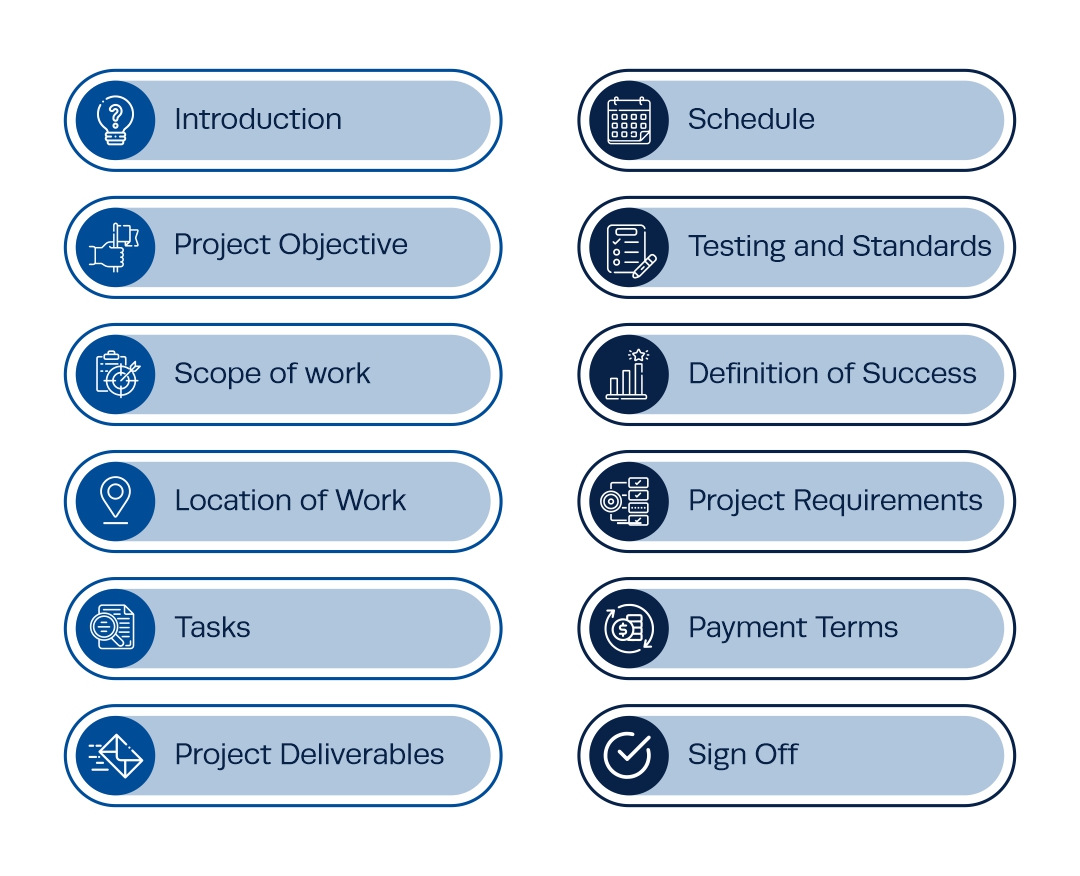
A statement of work is a detailed document that outlines project objectives, scope, tasks, deliverables, timelines, responsibilities, and acceptance criteria.
A statement of work (SOW) is a formal document that defines project scope, deliverables, timelines, and responsibilities between parties. This legally binding contract serves as the foundation for successful project execution, ensuring all stakeholders understand expectations, requirements, and outcomes.
In this comprehensive guide, you’ll learn what a statement of work is, how to write one effectively, the different types, key components, and access a free downloadable template.
What is a Statement of Work (SOW)?
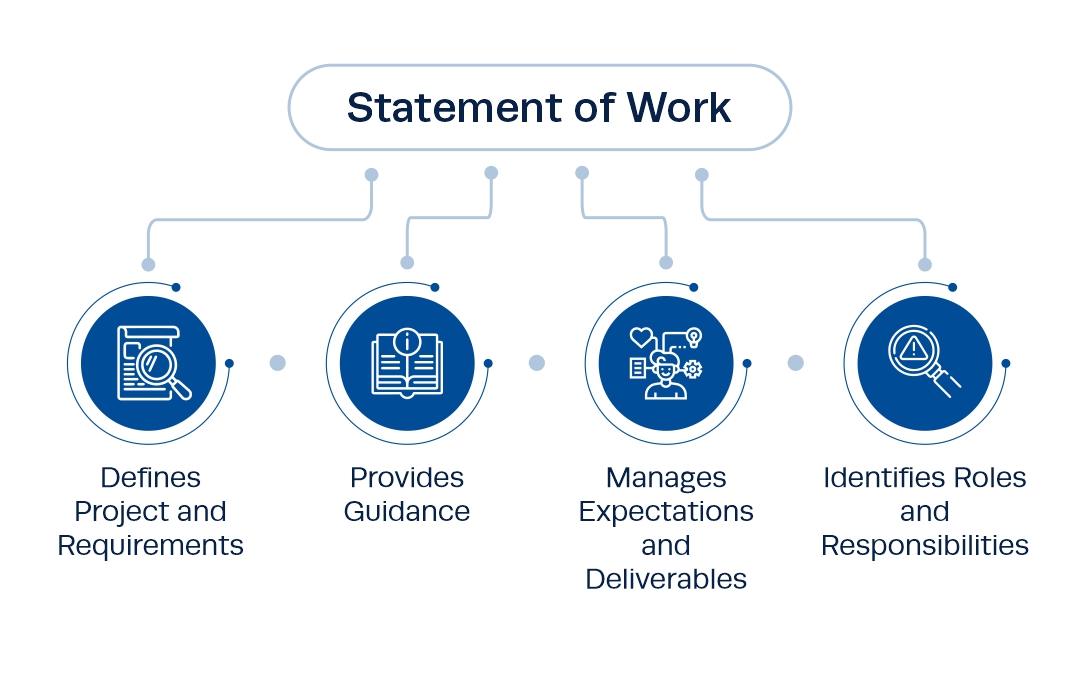
A statement of work is a detailed project document that outlines specific requirements, deliverables, timelines, work location, payment terms, and acceptance criteria. It serves as a contractual agreement between a client and a vendor or contractor, defining exactly what work will be performed and under what conditions.
The SOW acts as a blueprint for project success by establishing:
Clear project scope and objectives
Specific deliverables and quality standards
Timeline with milestones and deadlines
Roles and responsibilities for all parties
Payment terms and schedule
Acceptance criteria and sign-off procedures
SOW Full Form
SOW stands for “Statement of Work” in project management and procurement contexts. It’s one of the most critical documents in contract management and vendor relationships.
Why is a Statement of Work Important?
A well-crafted statement of work is essential for project success because it:
Prevents Scope Creep: By clearly defining what’s included (and excluded) from the project, an SOW prevents unauthorised expansion of work that can derail timelines and budgets.
Sets Clear Expectations: All parties understand exactly what will be delivered, when, and to what standard, eliminating ambiguity and misunderstandings.
Provides Legal Protection: As a legally binding document, the SOW serves as a contractual reference point in case of disputes or disagreements.
Enables Progress Tracking: With defined deliverables and milestones, project managers can measure progress against the agreed baseline.
Facilitates Communication: The SOW serves as a single source of truth that all stakeholders can reference throughout the project lifecycle.
Supports Risk Management: By clearly defining expectations, acceptance criteria, and change management procedures, the SOW helps identify and mitigate potential risks early.
Looking to write clear and effective project documents? Our Certified Project Management Diploma helps you master key project management documents, including Statements of Work, to set your projects up for success.
Statement of Work vs Related Documents
Understanding how an SOW differs from similar documents is crucial for effective project management:
SOW vs Scope of Work
While often used interchangeably, these terms have distinct meanings:
The scope of Work defines what work will be done (the tasks and deliverables)
Statement of Work is the comprehensive document that includes the scope, timelines, payment terms, responsibilities, and all contractual elements
Think of the scope of work as a component within the broader statement of work document.
SOW vs Contract
A contract is the overarching legal agreement between parties, while the SOW is often an attachment or exhibit that provides the detailed project specifications. The contract includes legal terms, liabilities, and general conditions, while the SOW focuses on the specific work to be performed.
SOW vs Master Service Agreement (MSA)
An MSA establishes general terms and conditions for an ongoing relationship between parties. Individual SOWs are then created for specific projects under the MSA framework. The MSA defines the “how we work together,” while SOWs define “what we’re working on now.”
SOW vs Request for Proposal (RFP)
An RFP is issued by a client seeking vendors to bid on a project. Once a vendor is selected, the next step is creating a detailed SOW that specifies exactly how the work will be executed.
SOW vs Work Breakdown Structure (WBS)
A WBS breaks down project deliverables into smaller, manageable components. It’s typically created from the SOW as a project planning tool, showing the hierarchical decomposition of work packages.
Types of Statement of Work
There are three main types of SOW documents, each suited to different project scenarios:
1. Design/Detail Statement of Work
This prescriptive SOW type specifies exactly how work should be performed, including:
Specific processes and procedures to follow
Required materials and quality standards
Detailed specifications and measurements
Compliance requirements
Best for: Manufacturing, construction, and government contracts where standards must be met precisely.
Risk: The buyer assumes more risk as they’re directing the approach.
Example: A government contract requiring construction to exact specifications and building codes.
2. Performance-Based Statement of Work
This outcome-focused SOW emphasises what needs to be achieved rather than how:
Project purpose and objectives
Required outcomes and deliverables
Quality standards and acceptance criteria
Performance metrics
Best for: Projects where flexibility in approach is desired, and innovation is encouraged.
Risk: The contractor assumes more risk as they’re responsible for determining the best approach.
Example: Developing a software solution that must achieve specific performance benchmarks.
3. Time and Materials (Level of Effort) Statement of Work
This flexible SOW type is based on hours worked and materials used:
Hourly rates for different skill levels
Material costs and unit rates
Time period for service provision
General scope of services
Best for: Temporary staffing, consulting services, and projects with evolving requirements.
Example: Hiring a contractor for IT support at an hourly rate for a three-month period.
4. Fixed-Price Statement of Work
This SOW locks in the budget, schedule, and deliverables:
Specific fixed budget
Firm timeline and deadlines
Defined deliverables
Best for: Projects with well-defined scope and minimal expected changes.
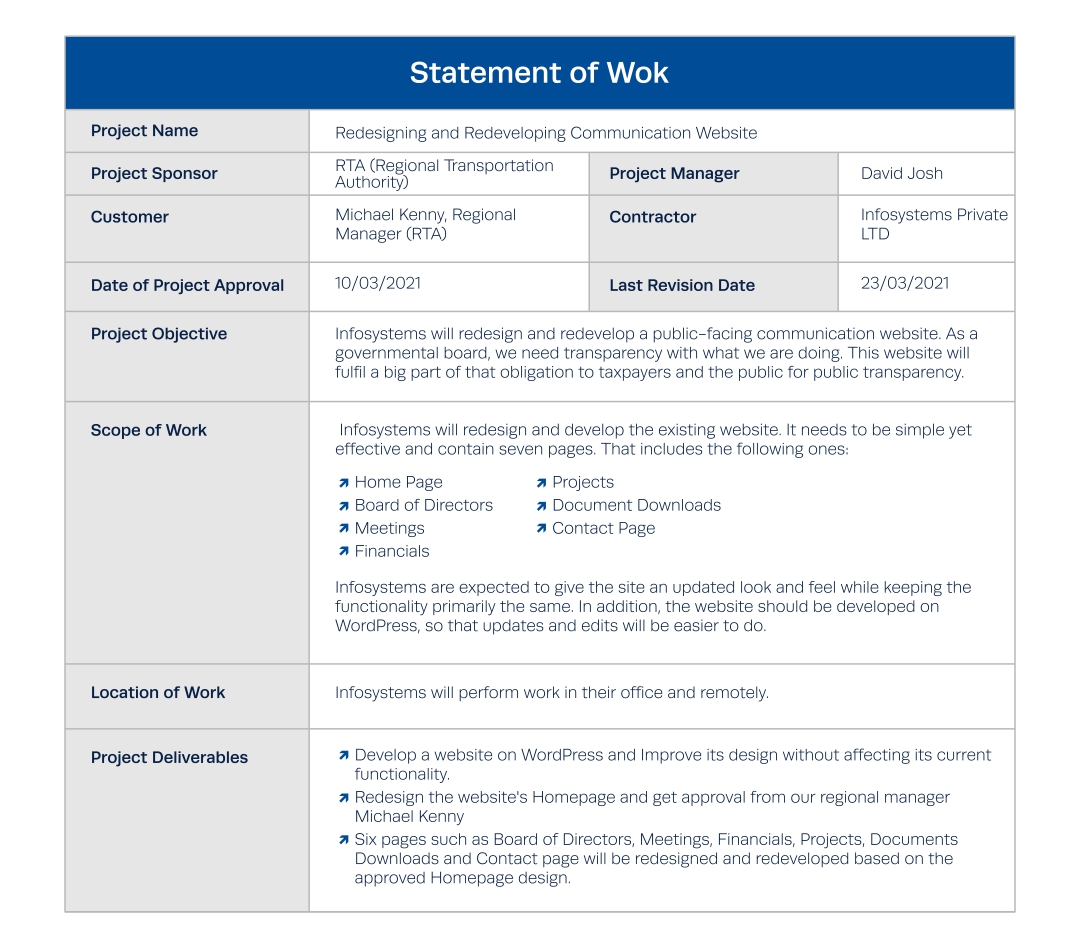
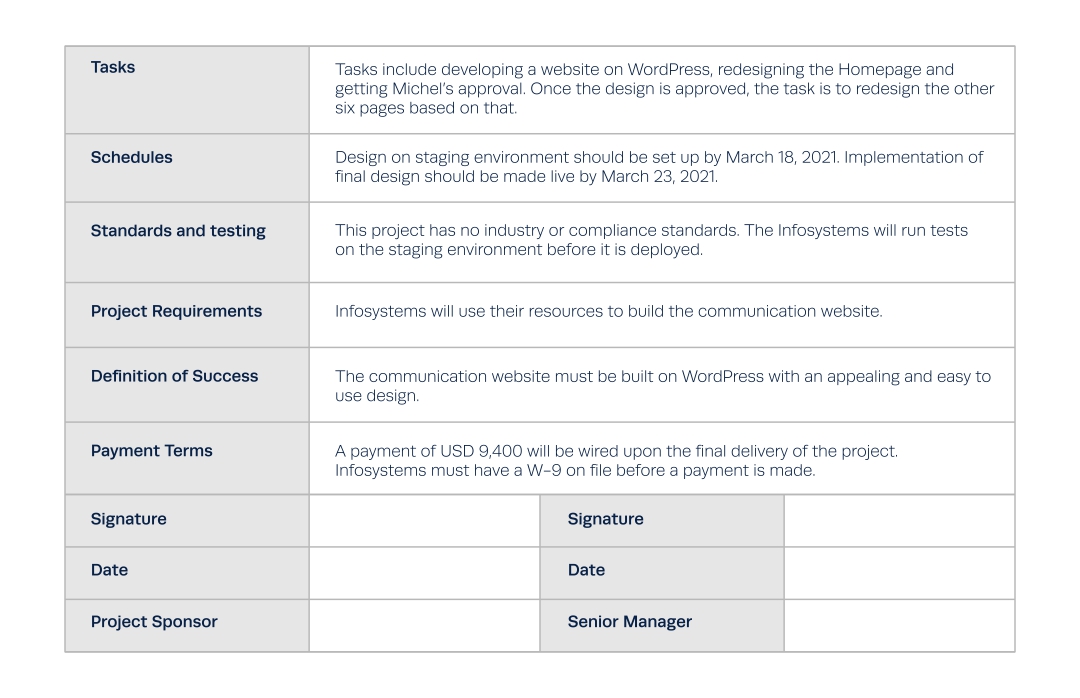
Below is a simplified example structure for a website development project:
STATEMENT OF WORK Website Development Project
1. Introduction This Statement of Work is between ABC Company (Client) and XYZ Web Solutions (Contractor) for the development of a new corporate website.
2. Project Objectives
Create a modern, responsive corporate website
Improve user experience and site performance
Increase lead generation by 30%
Launch within 3 months
3. Scope of Work
The Contractor will design and develop a new website, including:
Homepage and 5 main pages (About, Services, Portfolio, Blog, Contact)
Responsive design for mobile, tablet, and desktop
Content management system (WordPress)
Contact form with email integration
Google Analytics integration
SEO optimisation
4. Deliverables
Wireframes and design mockups (Week 2)
Developed website on staging server (Week 8)
Final website launched on production server (Week 12)
Being Too Vague: “Improve the system” vs. “Reduce system load time from 5 seconds to under 2 seconds”
Missing Exclusions: Not specifying what’s out of scope leads to scope creep
Unrealistic Timelines: Setting aggressive deadlines without considering dependencies
Ignoring Risk Factors: Not addressing potential obstacles or contingency plans
Incomplete Payment Terms: Failing to specify the exact payment schedule and conditions
No Change Process: Not establishing how scope changes will be handled
Assuming Shared Understanding: Not defining technical terms or industry jargon
Managing Your SOW Throughout the Project
An SOW isn’t a “set it and forget it” document. Here’s how to use it effectively:
Regular Reviews: Schedule milestone reviews to assess progress against the SOW
Track Changes: Document all approved changes with formal change orders
Communication: Reference the SOW in project communications to maintain alignment
Performance Measurement: Use SOW deliverables and timelines as success metrics
Dispute Resolution: Refer to the SOW as the authoritative source when disagreements arise
SOW Management Through MSP or VMS
Many organisations manage statements of work through Managed Service Provider (MSP) or Vendor Management System (VMS) platforms, which offer:
Enhanced Visibility: Real-time tracking of SOW status, spend, and performance
Cost Optimisation: Competitive bidding and rate management
Compliance: Automated policy enforcement and approval workflows
Performance Management: Supplier scorecards and accountability tracking
Efficiency: Streamlined processes from creation to payment
Integrated Talent Management: Holistic view of contingent workforce and services spend
Using an MSP/VMS transforms SOW management from a transactional task into a strategic advantage.
Frequently Asked Questions About Statement of Work
What is the full form of SOW?
SOW stands for Statement of Work. It’s a formal document used in project management and procurement to define the scope, deliverables, and terms of a project.
What is SOW in project management?
In project management, a statement of work is a detailed document that outlines project objectives, scope, tasks, deliverables, timelines, responsibilities, and acceptance criteria. It serves as the contractual foundation for vendor or contractor engagements.
How to write a statement of work?
To write an SOW: (1) Define project objectives and scope, (2) List specific deliverables and tasks, (3) Establish timelines and milestones, (4) Assign roles and responsibilities, (5) Set payment terms, (6) Define acceptance criteria, (7) Include change management process, (8) Get stakeholder review and approval.
What is the difference between SOW and SLA?
An SOW (Statement of Work) defines what work will be done, including tasks, deliverables, and timelines. An SLA (Service Level Agreement) defines how well services will be performed, including performance standards, quality metrics, and service levels.
What is the difference between SOW and the scope of work?
The scope of work is a section within the statement of work that specifically defines the tasks and deliverables. The statement of work is the complete document that includes scope, timelines, payment terms, roles, responsibilities, and all other contractual elements.
What is the difference between a statement of work and a contract?
A contract is the overarching legal agreement between parties, while the SOW is typically an attachment or exhibit that provides detailed project specifications. The contract includes legal terms and conditions; the SOW focuses on the specific work to be performed.
Who writes the statement of work?
Typically, the client or project manager drafts the initial SOW. In some cases, vendors may propose an SOW in response to an RFP. Regardless of who creates the first draft, both parties should review, negotiate, and approve the final document before work begins.
When should a statement of work be used?
Use an SOW when: (1) Engaging external contractors or vendors, (2) Starting a new project with defined deliverables, (3) Formalising work expectations, (4) Projects involve significant budget or complexity, (5) Multiple stakeholders need alignment on expectations.
What is an SOW template?
A SOW template is a pre-formatted document structure that includes standard sections and prompts for creating statements of work. Templates ensure consistency, save time, and help ensure no critical elements are overlooked.
Download Free Statement of Work Template
Get our professionally designed SOW template to streamline your project documentation process. The template includes:
Understanding how to create effective statements of work is crucial for project success. To further develop your project management expertise and master essential documentation like SOWs, consider our professional certification programs:
PMP Passport – Prepare for PMP certification and learn industry-standard best practices
Take the next step in your project management career with expert-led training from IPM, Ireland’s leading project management education provider since 1989.
Table of Contents:
See How Project Management Skills Can Boost Your Career
Highly in-demand across roles, industries, and experience levels
Don’t forget to copy and save this one-time code. It is valid until 31 July 2026.
Download Brochure
Thanks for downloading
Continue
Download Resource
Thanks for downloading
Continue
Download Brochure
Thanks for downloading
Continue
Download Brochure
Thanks for downloading
Continue
Download Brochure
Thanks for downloading
Continue
Download Brochure
Thanks for downloading
Continue
Download Internship Programme
Thanks for downloading
Continue
Waiting List
Thanks for downloading
Continue
We value your privacy
We use cookies to ensure you get the best experience of our website. By clicking “Accept”, you consent to our use of cookies.
FunctionalAlways active
The technical storage or access is strictly necessary for the legitimate purpose of enabling the use of a specific service explicitly requested by the subscriber or user, or for the sole purpose of carrying out the transmission of a communication over an electronic communications network.
Preferences
The technical storage or access is necessary for the legitimate purpose of storing preferences that are not requested by the subscriber or user.
Statistics
The technical storage or access that is used exclusively for statistical purposes.The technical storage or access that is used exclusively for anonymous statistical purposes. Without a subpoena, voluntary compliance on the part of your Internet Service Provider, or additional records from a third party, information stored or retrieved for this purpose alone cannot usually be used to identify you.
Marketing
The technical storage or access is required to create user profiles to send advertising, or to track the user on a website or across several websites for similar marketing purposes.


 All Courses
 Upcoming Course Dates
 Professional Courses
 Academy & Short Courses
 IPM Courses
 PMI Courses
 IPMA Courses
 PRINCE2 Courses
 Corporate Training
 Corporate Partnership
 Strategic Partnership
 IPM Competency Pathway
 Growth Partner
 Certification Overview
 IPMA Certification
 PMI Certification
 About IPM Hub
 IPM Membership
 EMEA Monthly Events
 Mentorship
 All Resources
 Expert Insights
 Ebooks & Toolkits
 Publish Your Writing
 IPM Jobs Portal
 The Institute
 Faculty
 Global Advisory Board
 Apply to Lecture or Volunteer
 Apply to Intern or Campus Ambassador
 Speak to an Advisor