All Courses
 Upcoming Course Dates
 Professional Courses
 Academy & Short Courses
 IPM Courses
 PMI Courses
 IPMA Courses
 PRINCE2 Courses
 Corporate Training
 Corporate Partnership
 Strategic Partnership
 IPM Competency Pathway
 Growth Partner
 Certification Overview
 IPMA Certification
 PMI Certification
 About IPM Hub
 IPM Membership
 EMEA Monthly Events
 Mentorship
 All Resources
 Expert Insights
 Ebooks & Toolkits
 Publish Your Writing
 IPM Jobs Portal
 The Institute
 Faculty
 Global Advisory Board
 Apply to Lecture or Volunteer
 Apply to Intern or Campus Ambassador
 Speak to an Advisor


hamburger__close



Project resource management is the structured process of identifying, acquiring, allocating, and monitoring everything a project needs to succeed, from people and equipment to time and budget. Defined within global frameworks such as the PMBOK Guide and the IPMA International Competence Baseline, it is a core professional competency that enables project managers to deliver outcomes reliably, efficiently, and sustainably. Far more than a scheduling task, it is the discipline that separates reactive project managers from genuinely high-performing ones.

Project resource management is the application of structured processes to plan, acquire, allocate, monitor, and optimise the resources required to complete a project within its agreed scope, time, and cost constraints. It ensures that the right resources are available at the right time, in the right quantity, and deployed toward the right activities. The purpose is not simply to fill a schedule but to create the conditions in which a project team can perform at its best while the project remains on track financially and operationally.
This process applies equally to large infrastructure programmes and small internal projects. The scale of the resource pool may differ, but the underlying discipline remains consistent. Within the PMBOK Guide (7th edition), resource management is embedded across the performance domains as a responsibility of the project manager, while the IPMA ICB treats resource management as a distinct practice competence element that practitioners must demonstrate at every level of certification. Understanding what project resource management is at this level of rigour is the starting point for every aspiring project manager.
Before any resource can be managed, it must first be categorised. Project resources fall into four broad types, each demanding a different management approach and each carrying distinct risks if poorly handled. A common question in professional development programmes is: What are the four types of resource management? The answer maps directly to these four resource categories.
Human resources are the people who perform project work. This includes permanent employees, contractors, consultants, subject matter experts, and any other individuals contributing effort. Human resources are the most complex to manage because they involve capability, availability, motivation, team dynamics, and welfare considerations. Effective human resource management means matching skills to tasks, managing workload to avoid burnout, and building a team environment where performance can flourish. Within the IPMA ICB, this connects directly to the leadership and teamwork competence elements.
Physical resources encompass materials, equipment, facilities, and technology infrastructure. A construction project requires plant machinery and raw materials; a software project requires development environments and hardware. The key challenge with physical resources is procurement lead time and logistics. A resource management plan must account for when physical resources need to be ordered, delivered, and made ready for use, since delays in physical resource acquisition are among the most common causes of schedule slippage.
Every resource ultimately translates into cost, but financial resources also need to be managed as a distinct input. Budget availability governs the extent to which human and physical resources can be engaged. Project managers must track resource expenditure against the forecast, identify variance early, and take corrective action before small overruns become systemic budget failures. Financial resource management intersects heavily with cost management processes in the PMBOK Guide.
Time is frequently overlooked as a resource in its own right, yet it is the one resource that cannot be replenished. Every hour of the project schedule represents a unit of resource capacity. When project managers speak of the five Ms of project resource management, they typically refer to Manpower, Materials, Machines, Money, and Minutes (time). This framing reinforces that time must be treated with the same rigour as any physical or human input, planned carefully and protected from unnecessary waste through sound scheduling and prioritisation.
Research consistently identifies poor resource management as one of the primary causes of project failure. When resources are misallocated, overextended, or simply unavailable at the moment they are needed, project timelines slip, costs escalate, and team morale deteriorates. The consequences are not abstract: a missed deadline on a product launch costs revenue; a cost overrun on a public infrastructure project erodes public trust; a burned-out project team generates high turnover and loss of institutional knowledge.
The business case for rigorous project resource management is compelling. Studies by the Project Management Institute have repeatedly shown that organisations with mature project management practices waste significantly less budget through poor performance than those without. Resource management maturity is a key contributor to that performance gap. When resource planning is integrated into the project management plan from the outset, project managers can make confident commitments, manage stakeholder expectations accurately, and respond to change without destabilising the entire delivery timeline.
Beyond organisational outcomes, resource management matters at the individual level too. A project manager who can competently plan, allocate, and optimise resources is demonstrably more valuable than one who cannot. The IPMA International Competence Baseline explicitly requires practitioners to demonstrate resource management competence as part of any IPMA certification assessment. It is not a peripheral skill; it sits at the heart of what it means to be a qualified project management professional.
Building a career in project management means developing resource management not just as a task but as a genuine professional competency. IPM’s range of project management courses provides structured, standards-aligned pathways for practitioners at every stage of their development, from those entering the profession for the first time to experienced managers seeking formal recognition of their skills.
Understanding project resource management as a process, rather than a one-time activity, is essential. The following step-by-step breakdown reflects both the PMBOK Guide process groups and the IPMA ICB practice elements, offering a standards-aligned view of how resource management unfolds across a project lifecycle.
Resource planning begins during the initiation or early planning phase, before any work is assigned or contracted. The project manager, working from the project scope and work breakdown structure, identifies every category of resource required to complete each deliverable. This produces a resource requirements document that feeds directly into the broader project management plan. Resource planning must also account for resource constraints: budget ceilings, organisational capacity limits, and external market availability all shape what is realistically achievable.
Once resources are planned, they must be acquired. For human resources, this may involve internal team assignment, recruitment, or contracting. For physical resources, it involves procurement, vendor negotiation, and logistics planning. Acquisition is not a passive step. Project managers must actively engage HR departments, procurement teams, and line managers to secure commitments. A resource that is identified in a plan but never formally confirmed is a risk, not an asset. Early engagement with resource owners significantly reduces the likelihood of last-minute shortfalls.
Allocation is the assignment of confirmed resources to specific tasks within the project schedule. It involves matching the right person or material to the right activity at the right time. Effective allocation requires visibility of each resource’s availability, existing commitments, and capability level. Over-allocation, where a team member is assigned more work than they can realistically perform, is one of the most common errors in project execution and one of the most damaging to delivery quality and team wellbeing.
Monitoring resource utilisation throughout the project lifecycle is what distinguishes proactive project managers from reactive ones. Tracking actual resource consumption against planned consumption reveals variances early, when corrective action is still relatively straightforward. Key metrics include utilisation rate (the percentage of available capacity being used productively), cost performance index (a measure of budget efficiency), and schedule performance index (a measure of timeline efficiency against resource consumption).
Optimisation encompasses the ongoing adjustments a project manager makes to ensure resources are deployed as efficiently as possible. This includes re-sequencing activities to better match resource availability, re-allocating capacity from lower-priority work to critical path tasks, and applying formal techniques such as resource levelling and resource smoothing. Optimisation is not a one-time event at the end of the project; it is a continuous responsibility throughout the delivery lifecycle.
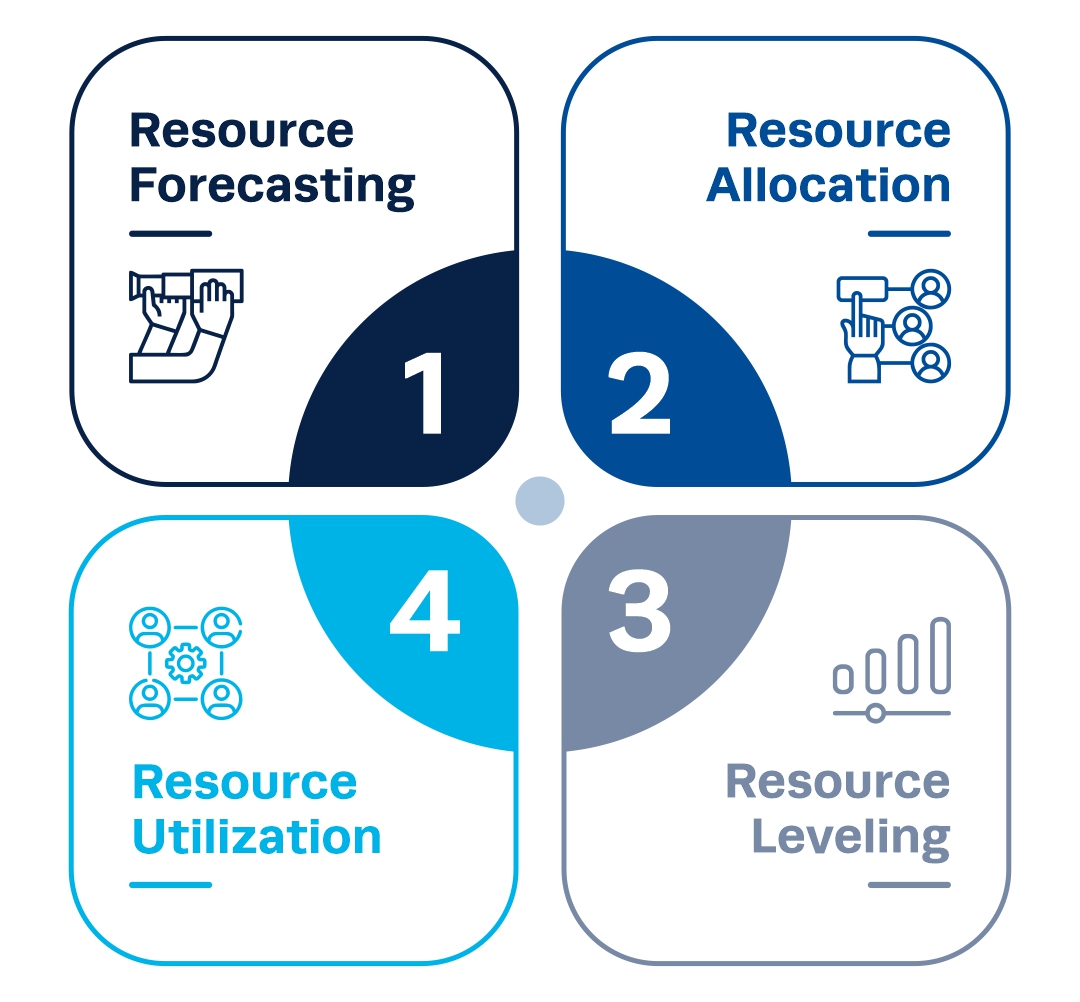
Some of the most widely practised resource management techniques ensure project success and optimal resource use. These techniques vary in purposes but should be employed in conjunction for the best possibility of project success and resource use.
These techniques are discussed as follows:
Just as the name suggests, resource forecasting involves two stages. The first one is the identification of current resource requirements, whereas the second stage is the recognition of future resource needs which might arise.
Therefore, the current capacity and quantities of available resources must be considered to forecast against current and future needs required for project completion.
Both of these, when correctly estimated and accounted for, can make the difference between project success and project failure.
After a forecast of current and future needs is made, the next step is to manage resources to allocate them to such timeframes appropriately. This process considers budget, important tasks to manage and their priority levels. This also involves the process of allocating teams as well.
Project tasks will be identified, and certain resources will be assigned to them in order of current and future schedules. Assigned inputs can then be made use of without further delays.
Resource levelling involves offsetting overlapping resources that have been employed. Various activities of projects require the same type of resources. Consequently, adjusting such resources considering their capacity, task priorities, and deadlines is the essence of resource levelling.
Certain tasks require more inputs, whereas others require less of such inputs or resources; that is where levelling techniques come into play. Not only does levelling help increase productive output, but it also serves as a tool for the prioritisation of important tasks.
Resource utility is the standard of making sure resources are employed in a way to maximise production output. This is especially applicable in the case of employees. A standard way of numerically calculating this is by dividing the actual hours utilised of a resource by the total utilisable hours available.
This is particularly useful in determining the efficacy of an employee in achieving tasks when allocating a specific timeframe in a given cost schedule.
One of the most significant differentiators between organisations that manage projects well and those that struggle is the extent to which their project managers understand and apply recognised global standards. Project resource management is not a concept invented by software vendors or consultants; it has been codified, refined, and validated over decades by the world’s leading professional bodies.
The PMBOK Guide, published by the Project Management Institute, has long treated resource management as a distinct knowledge area. In earlier editions, the Project Resource Management knowledge area included specific processes such as Plan Resource Management, Estimate Activity Resources, Acquire Resources, Develop Team, Manage Team, and Control Resources. While the 7th edition shifted toward a principles-based model, the underlying resource management responsibilities remain central to the performance domains, particularly the Team performance domain and the Delivery performance domain. Understanding Project Resource Management in PMBOK terms gives practitioners a process-level vocabulary that is recognised and respected across industries and geographies.
The IPMA International Competence Baseline (ICB) takes a competence-centred view of project management, organising practitioner knowledge and skill into three domains: People, Practice, and Perspective. Resource management appears explicitly within the Practice domain as a competence element that candidates must demonstrate at every level of IPMA certification, from IPMA Level D through to IPMA Level A. The ICB requires practitioners to show not just that they know what resource management is, but that they can apply it contextually, adapt it to complex and ambiguous project environments, and lead others in doing the same. Pursuing an IPMA certification is one of the most effective ways to validate resource management competence against an internationally recognised standard.
The alignment between PMBOK and IPMA ICB on resource management is not coincidental. Both frameworks reflect decades of practitioner research and validation. Where PMBOK provides a process-level map of resource management activities, the IPMA ICB describes the competence behaviours that make those processes effective in practice. Together, they offer project managers a comprehensive and complementary picture of what excellent resource management looks like.
Even experienced project managers encounter resource management challenges. The discipline is inherently complex because resources are dynamic: people get ill, budgets are revised, suppliers miss delivery dates, and organisational priorities shift. What separates high-performing project managers is not the absence of resource problems but the speed and composure with which they identify and resolve them.
One of the most frequently encountered challenges is resource conflict, where the same person or piece of equipment is needed simultaneously by two or more projects or workstreams. This is especially common in matrix organisations where functional managers and project managers share authority over the same pool of people. The solution lies in early visibility: a project manager who surfaces resource demands during the planning phase, before work begins, is far better positioned to negotiate priority than one who discovers a conflict mid-execution. Formal escalation paths and portfolio-level resource governance structures help organisations resolve these conflicts systematically rather than through ad-hoc negotiation.
Assigning the right number of people to a task is only half the equation. Those people must also have the right skills. Skill gaps, where a team member is allocated to work for which they are not fully prepared, are a significant source of quality risk and schedule delay. The remedy involves a thorough skills assessment during the resource planning phase, combined with proactive investment in training and development. A project manager who builds learning time into the project plan acknowledges the reality of skill development and protects delivery quality in the process.
Over-allocation is a chronic problem in project-driven organisations. When team members are committed to multiple projects simultaneously, each demanding full attention, the inevitable result is reduced quality, missed deadlines, and eventually burnout. Preventing over-allocation requires honest capacity planning at the outset and the courage to push back when demands exceed what is realistically achievable. Resource levelling and smoothing techniques provide the analytical foundation for these conversations, turning what might otherwise feel like a personal complaint into an evidence-based management decision.
Many resource management failures are not strategic failures but documentation failures. When resource assignments are held in individuals’ heads rather than in a shared resource plan, the project manager loses situational awareness. When availability data is not kept up to date, allocation decisions are made on false assumptions. The foundation of good resource management practice is disciplined documentation: maintained resource registers, up-to-date assignment records, and regular resource reviews that keep the plan aligned with reality. A robust resource management plan, reviewed and updated at each project stage gate, is the single most effective preventive measure against resource-driven project failure.
A project resource management plan is a formal document that describes how resources will be identified, acquired, managed, and released throughout the project lifecycle. It is a subsidiary plan within the overall project management plan template and should be developed during the planning phase, before execution begins. The following structure reflects best practice aligned to both the PMBOK Guide and the IPMA ICB.
The first section of the plan should establish the organisational structure of the project team. This includes a project organisation chart, a description of each role’s responsibilities, and a RACI matrix mapping those roles to the key deliverables and decisions in the project. Clear role definition at the outset prevents the ambiguity that leads to duplicated effort, accountability gaps, and interpersonal conflict later in the project.
The next step is to systematically identify every resource required to complete the project scope. Working through the work breakdown structure task by task, the project manager estimates the type, quantity, and duration of resources needed for each activity. These estimates feed into the project schedule and budget baseline. The accuracy of resource estimation is a significant factor in overall project performance; bottom-up estimation, where each task is estimated individually, consistently produces more reliable results than top-down approaches that apportion a total budget without granular analysis.
The plan should describe how each category of resource will be acquired: which roles will be filled internally, which will require external recruitment or contracting, and which physical resources will be procured through the organisation’s standard procurement process. It should also address onboarding: how new team members will be integrated, what orientation or induction is required, and who is responsible for ensuring that all team members have the information, access, and support they need to contribute effectively from the outset.
A resource calendar documents when each resource is available to the project. It accounts for organisational holidays, pre-committed leave, part-time arrangements, and any other constraints on availability. Without an accurate resource calendar, the project schedule is built on assumptions that will inevitably be violated, producing an unrealistic plan that erodes team confidence as soon as delivery begins. Many organisations now use shared resource calendars at the portfolio level to give project managers real-time visibility of availability across the entire resource pool.
Where skill gaps have been identified during resource planning, the plan should document the training or development interventions required to close them. This is not merely a welfare consideration; it is a delivery risk mitigation measure. Training timelines must be factored into the project schedule, and a budget must be allocated. The plan should specify who is responsible for arranging and monitoring each development activity.
The resource management plan should address how resources will be released at the end of the project or at project phase transitions. People need to know when their assignment ends so that their line managers can plan their next engagement. Physical resources must be returned, decommissioned, or transferred according to established procedures. Neglecting the release phase creates resource hoarding behaviour, where project managers retain resources beyond their genuine need, blocking availability for other projects in the portfolio.
It is possible to learn the vocabulary of resource management in an afternoon. It takes considerably longer to develop the competence to apply it confidently across the full variety of project environments a professional will encounter over a career. This distinction between knowledge and competence is central to the way bodies like IPMA and PMI have designed their certification frameworks.
The IPMA ICB describes resource management competence not just as the ability to produce a resource plan but as the ability to make sound resource decisions under uncertainty, to lead team members through resource constraints, and to advise organisational stakeholders on the resource implications of scope or timeline changes. These are behaviours that develop through structured education, reflective practice, and progressively more complex project experience. They cannot be acquired by reading a checklist or configuring a software tool.
For practitioners looking to develop this competency formally, project management courses that align with the PMBOK Guide or IPMA ICB provide a structured pathway from foundational understanding to applied professional skill. The investment in formal education pays dividends not only in career progression but in measurably better project outcomes. Organisations that develop resource management competence systematically across their project management population consistently outperform those that treat it as an incidental skill to be picked up on the job.
It is also worth considering where resource management sits within the broader picture of project management maturity. In organisations at the lower end of the maturity scale, resource management is reactive and individual: each project manager makes resource decisions in isolation, with little visibility of the wider portfolio. At higher maturity levels, resource management becomes a coordinated, portfolio-wide capability, governed by shared standards, supported by consistent tooling, and informed by accurate data. The journey from one to the other begins with individual practitioners developing the competence that, over time, elevates the entire organisational practice.
Project resource management is the process of identifying, acquiring, allocating, monitoring, and optimising everything a project needs to succeed, including people, materials, equipment, budget, and time. It is a core professional competency aligned to frameworks such as the PMBOK Guide and the IPMA International Competence Baseline, and it is fundamental to delivering projects on time, within budget, and to the required quality standard.
The main steps are: planning (defining what resources are needed and when), acquiring (securing team members, materials, and equipment), allocating (assigning resources to specific tasks), monitoring (tracking utilisation and performance against the plan), and optimising (adjusting allocations to resolve conflicts, reduce waste, and keep the project on track). These steps are repeated iteratively throughout the project lifecycle rather than performed once at the outset.
Poor resource management is one of the leading causes of project failure, contributing to schedule delays, cost overruns, and team burnout. When resources are planned, allocated, and monitored rigorously, project managers can make reliable commitments, respond to change without destabilising delivery, and create the conditions in which their teams can perform at their best. It is also a key competency assessed in IPMA and PMI certification programmes.
A resource management plan typically includes a project organisation chart, role and responsibility definitions, a RACI matrix, resource estimation for each work package, acquisition and procurement strategies, resource calendars showing availability, identified training requirements, and a resource release plan for the end of the project or phase. It forms a subsidiary plan within the broader project management plan and should be maintained and updated throughout the project lifecycle.
The IPMA International Competence Baseline includes resource management as a Practice competence element that candidates must demonstrate at all certification levels. Assessment involves showing that the practitioner can plan, acquire, and manage resources in real project contexts, make sound decisions under uncertainty, and adapt their approach to complex organisational environments. Candidates at higher certification levels are also expected to lead and develop resource management capability in others.